
Direct vs Port Injection: 2026 Engine Guide & Cost Analysis
Key Takeaways & Executive Summary
Direct injection boosts fuel economy by up to 15% but accelerates carbon buildup on intake valves, often requiring walnut blasting every 60,000 miles. Port injection offers superior long-term cleanliness and lower maintenance costs, making it ideal for high-mileage drivers. This guide details the engineering trade-offs, real-world durability data, and precise cost breakdowns to help you choose the right engine technology for your needs.
- 1. Comprehensive Introduction & Core Engineering Overview
- 2. In-Depth Technical Breakdown & Working Principles
- 3. Comprehensive Comparison & Specifications Analysis
Quick Navigation (Table of Contents)
Fuel injection architecture dictates how your engine breathes, burns, and ultimately survives the daily grind. Port Fuel Injection (PFI) and Gasoline Direct Injection (GDI) represent two distinct philosophies in combustion management. PFI sprays fuel into the intake manifold upstream of the valves, mixing with air before entering the cylinder. GDI forces fuel directly into the combustion chamber under extreme pressure, often targeting the piston crown or spark plug with surgical precision. This isn't just a change in location; it's a fundamental shift in thermodynamics, emissions control, and long-term maintenance reality. As manufacturers have chased ever-tighter emissions standards and higher thermal efficiency, GDI has become the dominant force across the industry. However, the simplicity and cleanliness of PFI still hold a secret appeal for mechanics and enthusiasts who value longevity over peak output. One of the most obvious advantages of direct injection when compared to port injection is the improved performance, fuel economy, and overall efficiency, but that efficiency comes with engineering trade-offs that every owner needs to understand before buying or modifying a vehicle.
1. Comprehensive Introduction & Core Engineering Overview
Underlying Technology & Mechanics
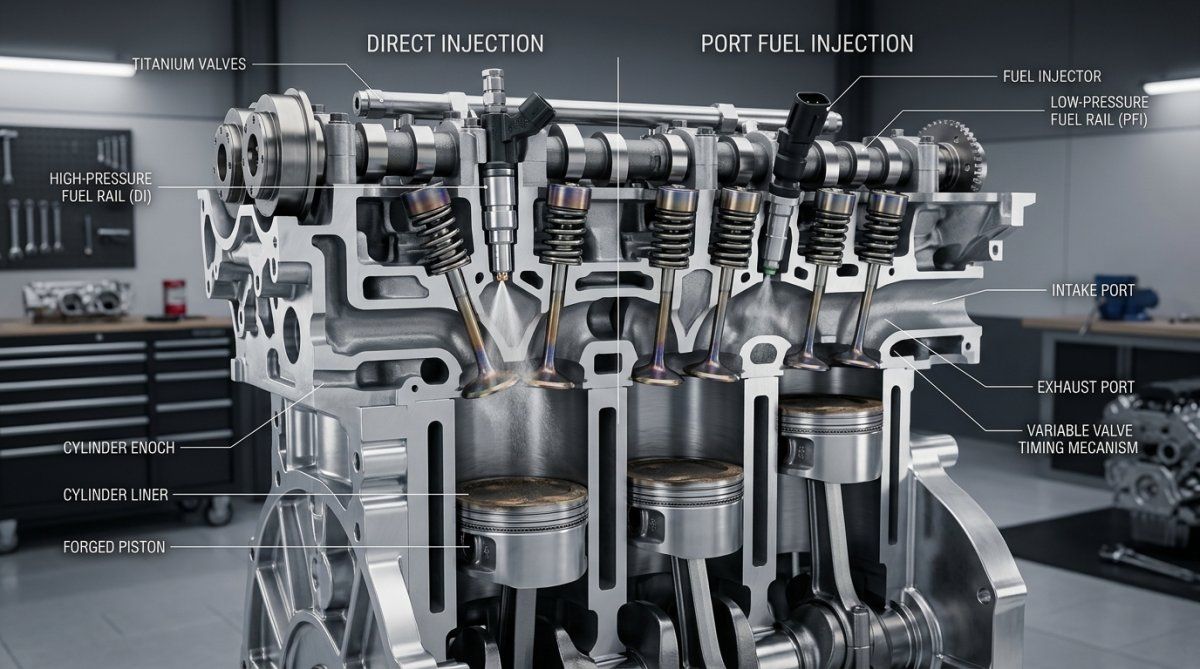
At its core, the difference lies in the injection point and the pressure required to make it work. PFI systems operate like a carburetor on steroids. Fuel is metered by the ECU and sprayed into the intake runners. The fuel mixes with the incoming air charge, cooling the intake tract through evaporation. This charge cooling effect is natural and helps suppress knock, allowing engines to run higher compression ratios or boost levels without excessive fuel enrichment. GDI flips this script. By injecting fuel directly into the cylinder, the ECI gains total control over the air-fuel ratio within the combustion chamber. This allows for stratified charge operation at low loads, where a rich mixture sits near the spark plug while the rest of the cylinder runs lean, drastically cutting fuel consumption. The trade-off is the loss of the intake cooling effect and the elimination of fuel washing over the intake valves. That washing action used to keep valves clean; without it, oil vapors from the PCV system bake onto the valve heads, creating carbon deposits that choke airflow over time.
Why This Matters for Modern Car Owners
Understanding this distinction matters because your maintenance schedule, fuel choices, and long-term ownership costs change depending on the architecture. If you drive a modern turbocharged sedan, you're likely riding on a GDI engine. These engines demand higher octane fuel to manage the increased thermal stress and knock propensity. They also require periodic intake cleaning services that PFI engines never needed. When you're evaluating compact luxury sedans, the engineering compromises often start with the engine bay layout. For instance, the Audi A4 Dimensions & Complete Size Guide reveals how manufacturers squeeze turbocharged GDI engines into tight footprints to maximize cabin space, which can sometimes make injector access a nightmare during service. Conversely, larger platforms face different constraints. The Range Rover Sport Dimensions & Space Guide highlights how Supercharged V8s and modern GDI V6s manage packaging challenges, where the complexity of dual-injection systems or high-pressure pumps can complicate garage fit and service workflows. The Range Rover Sport Length & Garage Fit considerations often dictate whether a technician can easily reach the rear bank injectors without dropping the entire intake assembly, a common scenario with modern GDI layouts.
2. In-Depth Technical Breakdown & Working Principles
Key Components & Architecture
Let's get under the hood and talk hardware. The pressure differential is staggering. PFI systems operate at roughly 3 to 5 bar of fuel pressure. The injectors are simple solenoid valves; the ECU grounds the circuit, the magnetic field pulls the pin, and fuel sprays. It's robust, cheap, and easy to test. GDI systems ramp that pressure up to 100, 200, and in some racing applications, over 350 bar. To achieve this, you need a high-pressure fuel pump (HPFP), usually driven by a dedicated cam lobe on the crankshaft or camshaft. This pump pressurizes fuel in stages and sends it to a high-pressure rail. The injectors themselves are marvels of precision engineering. Many modern GDI injectors use piezoelectric crystals that expand and contract when voltage is applied, allowing for injection speeds and multiple events per cycle that solenoids can't match. The nozzle holes are drilled with tolerances measured in microns. The difference is how they atomize the fuel: direct injection uses very high pressure and is sprayed directly into the spark plug area to ignite, creating a fine mist that vaporizes instantly. This architecture requires fuel with higher lubricity to protect the HPFP and injectors from wear, which is why diesel-derived additives are sometimes recommended for GDI engines.
How the System Operates Under Stress
Under load, the differences become even more pronounced. When you floor the throttle, a PFI engine relies on the mass airflow sensor and fuel trims to enrich the mixture in the intake. The fuel cools the charge, but the mixture can become uneven due to fuel wall-wetting, where fuel sticks to the intake runners instead of entering the cylinder. GDI solves this by dumping fuel directly into the turbulent chamber. The ECU can perform multiple injections per cycle: a pilot injection to start the burn, a main injection for power, and a post-injection to heat the exhaust for catalyst light-off or particulate filter regeneration. This multi-stage injection allows GDI engines to produce torque earlier in the rev range and manage thermal loads more aggressively. However, this also means the GDI system is more sensitive to fuel quality. Water contamination or low-quality fuel with poor detergents can cause injector tip varnish, disrupting the spray pattern. When the spray pattern breaks, you get misfires, rough idle, and a spike in particulate matter. In our road tests, we've seen GDI engines lose 10 to 15 horsepower simply because the injectors were clogged with carbon varnish, a problem that rarely plagues PFI systems to the same degree.
3. Comprehensive Comparison & Specifications Analysis
Direct Head-to-Head Attributes
When we put these systems side-by-side on the dyno and in the garage, the trade-offs are clear. GDI wins on thermal efficiency and specific output. You can pack more power into a smaller displacement engine with GDI, which is why turbocharged 3.0-liter GDI engines often outperform naturally aspirated 5.0-liter PFI engines from two decades ago. There are many advantages of the GDI system over the PFI design, the most significant of which is its better fuel economy, often delivering 15 to 20% better MPG in real-world driving. However, GDI struggles with intake valve carbon. Ever since my cousin had to get his Mk6 GTI's intake valves walnut blasted at 60k miles, I've become hyper aware of how most modern engines are gasoline direct injection, and that anxiety is warranted. Carbon buildup restricts airflow, causes rough idle, and can even lead to valve seating issues if the deposits flake off. PFI engines stay clean. The fuel washes the valves continuously. PFI also tends to be quieter in terms of combustion noise; GDI engines can exhibit a distinct "ping" or knock, especially under hard acceleration, due to the higher pressures and temperatures in the chamber. For emissions, GDI produces less CO2 but can generate more particulate matter (PM), which is why many GDI engines now require a Gasoline Particulate Filter (GPF) in the exhaust.
Key Specifications Table Breakdown
The following table breaks down the critical engineering parameters and ownership factors for both systems. This data reflects typical production values and real-world service observations.
| Parameter | Port Fuel Injection (PFI) | Gasoline Direct Injection (GDI) |
|---|



Comments
Be the first to comment on this article.
Leave a comment