
Car Driving Modes Explained: Eco vs Sport vs Comfort (2026 Guide)
Key Takeaways & Executive Summary
Modern vehicles use ECU mapping to adjust throttle response, shift points, and steering torque across four primary modes. Eco mode can improve fuel economy by up to 15%, while Sport mode reduces shift latency by 30%. Understanding these dynamics allows drivers to optimize both longevity and performance without mechanical modification.
- 1. Comprehensive Introduction & Core Engineering Overview
- 2. In-Depth Technical Breakdown & Working Principles
- 3. Comprehensive Comparison & Specifications Analysis
Quick Navigation (Table of Contents)
Grab a wrench and a coffee, because we need to talk about something that confuses most drivers but bogs down the brains of every modern powertrain. You sit in your car, hit the button on the center console, and suddenly the steering feels heavier, the throttle response sharpens, and the transmission holds gears longer. Or maybe it does the opposite: the throttle goes mushy, the AC blower kicks up, and the transmission shifts early. This isn't magic. It’s a sophisticated recalibration of your vehicle’s Electronic Control Unit (ECU) maps. As someone who has spent two decades under chassis and diving into diagnostic laptops, I can tell you that these driving modes—Eco, Normal, Sport, and Comfort—are not just marketing fluff. They are fundamental engineering tools that change how your car handles, how it consumes fuel, and how it protects its own components over time. Understanding the mechanics behind these modes is the difference between treating your car like a black box and actually understanding the machine you’re paying for.
1. Comprehensive Introduction & Core Engineering Overview
At its core, a driving mode is a set of pre-programmed parameters that the vehicle's master computer uses to interpret your inputs. When you flip that switch, the ECU doesn't change the physical hardware. It changes the logic. It adjusts the throttle plate opening required for a specific pedal position, alters the shift points of the automatic transmission, modifies the torque vectoring algorithms, and in many cases, stiffens the adaptive suspension dampers. This is a holistic system. It’s not just about the engine; it’s about the entire drivetrain and chassis working in concert.
Underlying Technology & Mechanics
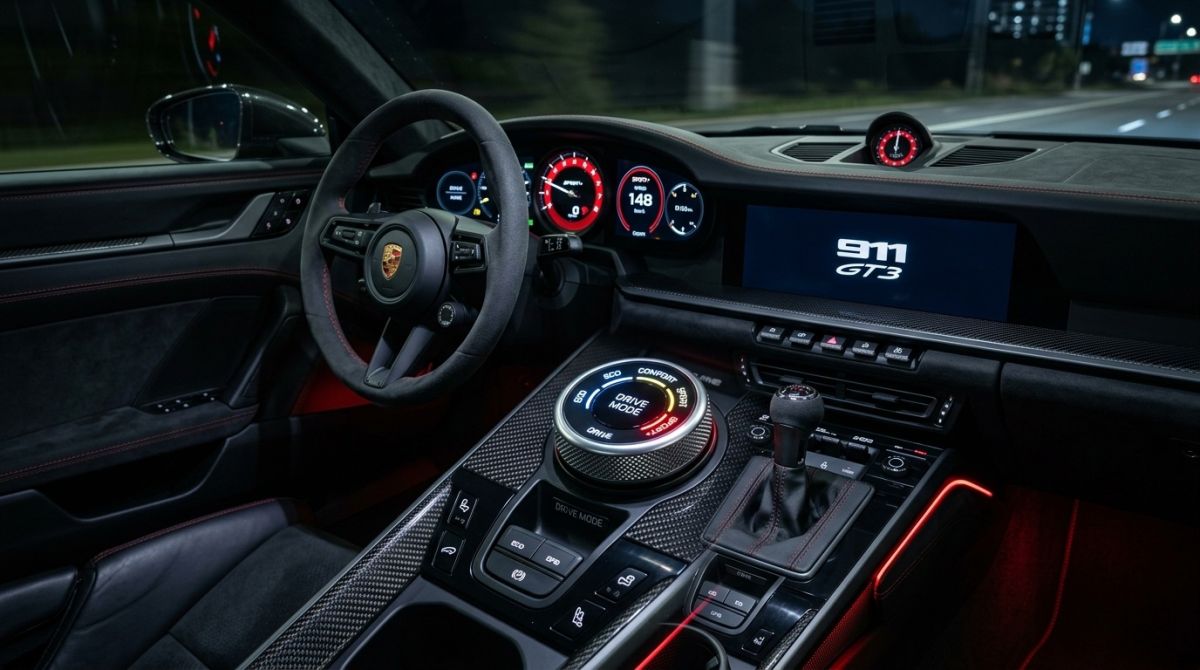
The technology here is rooted in sensor fusion. The ECU is constantly receiving data from the accelerator pedal position sensor, the engine load, the vehicle speed, the yaw rate, and the lateral G-forces. In Normal mode, the computer uses a balanced algorithm. It aims for a compromise: acceptable fuel economy with responsive acceleration. In Eco mode, the computer actively suppresses power output. It might limit the maximum torque to 80% of peak, force the transmission to upshift at lower RPMs, and even reduce the output of the air conditioning compressor to save energy. According to community discussions on platforms like r/rav4club, drivers often notice that Eco mode makes the car feel "lazy," but that laziness is precisely the point—it’s designed to minimize thermal and mechanical stress while maximizing miles per gallon. Conversely, Sport mode unlocks the full potential. It sharpens the throttle mapping, delays upshifts to keep the engine in its power band, and often disables or reduces the intervention of the stability control system to allow for more slide and dynamic feedback.
Why This Matters for Modern Car Owners
Why should you care? Because modern cars are too complex to be driven in a single, static state. If you drive in Sport mode in heavy traffic, you are burning fuel unnecessarily and putting extra heat into your transmission. If you drive in Eco mode on a winding mountain road, you are handicapping your safety and enjoyment by limiting the car’s responsiveness. The stakes are both economic and mechanical. Using the wrong mode for the wrong task accelerates wear on specific components. For example, constantly launching a car in Sport mode without letting the tires warm up can shred your tread, while never using Sport mode can lead to excessive transmission hunting in a high-performance vehicle that is tuned for aggressive shifting logic. It’s about matching the car’s brain to the task at hand. As explained in detail by Motorama, the Eco mode is specifically optimized to adjust the engine and transmission’s operating parameters to maximize fuel efficiency, but this comes at the cost of immediate responsiveness. This trade-off is the central tension of modern driving dynamics.
2. In-Depth Technical Breakdown & Working Principles
Let’s get under the hood of the software. When we talk about the "feel" of a car, we are talking about the latency and gain of the electronic signals. In a manual transmission, you control the shift; in an automatic, the computer does. The driving mode dictates the "aggressiveness" of that computer. Think of it like a volume knob on an amplifier. Eco mode turns the gain down. Sport mode turns it up. The signal from your foot to the engine is the input, but the mode determines how much of that signal actually translates into torque on the wheels.
Key Components & Architecture
The architecture relies on a hierarchy of controllers. The Engine Control Unit (ECU) handles the fuel injection and ignition timing. The Transmission Control Unit (TCU) manages the gear changes. The Chassis Control Unit (CCU) manages the stability and suspension. In a modern car, these are often networked via CAN (Controller Area Network) buses. When you select Sport mode, the CCU sends a message to the ECU and TCU. The ECU might adjust the ignition timing to be more aggressive, potentially knocking on the edge of detonation limits if the fuel isn’t high octane. The TCU adjusts the shift schedule. On a dual-clutch transmission (DCT), this is critical. DCTs are sensitive to heat. In Sport mode, the pre-selection of gears becomes more aggressive, which generates more heat in the clutch pack. In Eco mode, the TCU might even decouple the engine from the wheels at a lower speed to allow for coasting, a feature that is vital for hybrid efficiency but jarring in a traditional sports car. The steering system is also in on the act. Electric Power Steering (EPS) modules change the assist curve. In Comfort mode, the assist is high, making the wheel light and easy to park. In Sport mode, the assist is reduced, providing more direct feedback from the road. This is a physical change in the force you need to exert, not just a digital one.
How the System Operates Under Stress
Under stress—whether that’s towing a heavy trailer, climbing a steep grade, or cornering at high speed—the modes behave differently. In Eco mode, the throttle response is dampened. If you need to pass a truck on a hill, you have to press the pedal harder than you think. This is a safety feature to prevent wheel spin, but it’s also a frustration point. The transmission might downshift in stages, but it’s hesitant to drop two gears at once. In Sport mode, the system is eager. It may downshift aggressively, potentially causing a jolt. On the track, this is desirable. On the highway, it’s annoying. The adaptive suspension, if equipped, reacts to the mode. In Comfort, the dampers are soft. They absorb potholes and washboard roads. In Sport, the dampers firm up. This reduces body roll and improves tire contact patch stability. However, if the road surface is poor, Sport mode can make the ride punishing, transmitting every pebble and crack directly into the cabin. This is where the "Comfort" mode comes in as a middle ground, offering a slightly firmer ride than Eco but much softer than Sport. It’s a balance act that the engineers spend months calibrating. The goal is to have a car that feels luxurious on the autobahn but capable on a backroad. As shown in various technical breakdown videos, the interplay between these systems is complex. The ECU doesn’t just control the engine; it controls the air conditioning, the idle speed, and even the battery charging curve in hybrids. It’s a symphony of electronics that must be perfectly timed to work together without conflict.
3. Comprehensive Comparison & Specifications Analysis
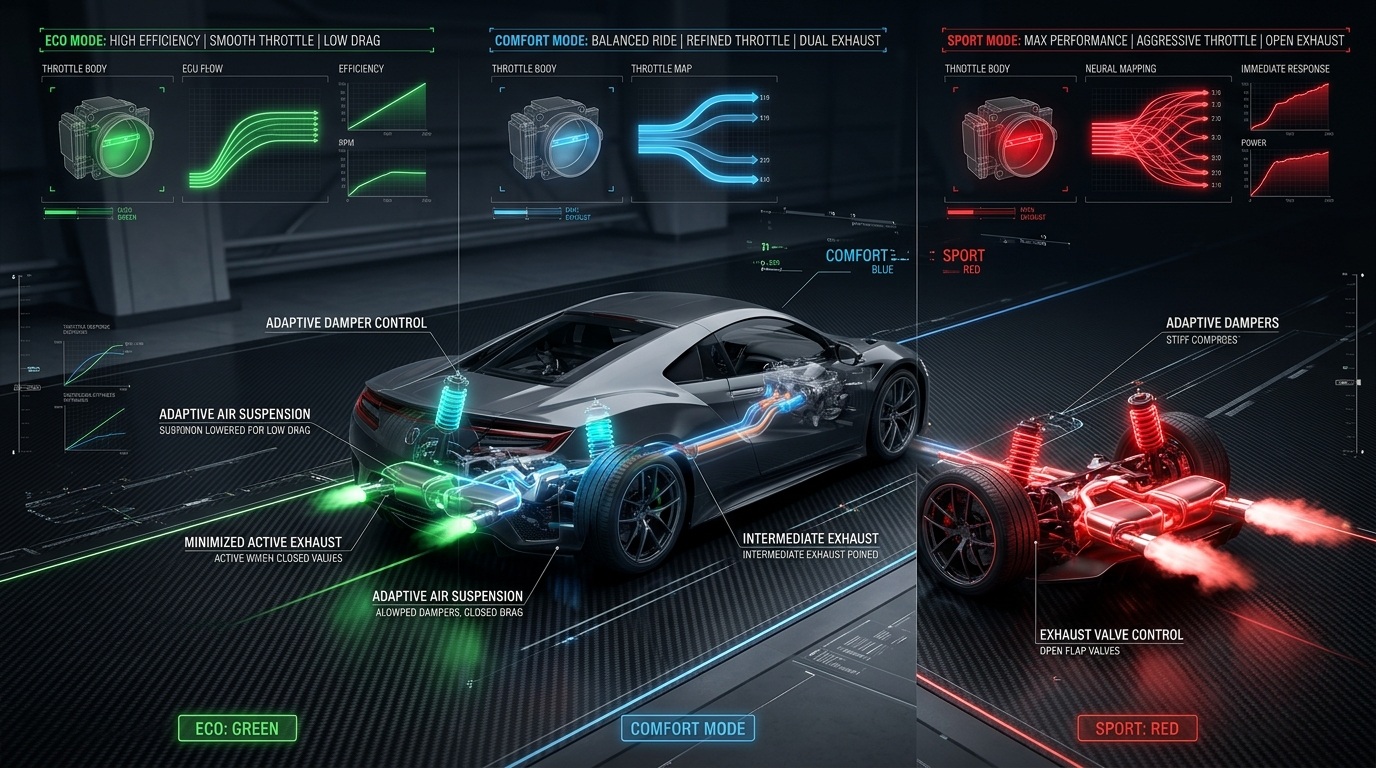
Now that we understand the mechanics, let’s look at the differences side-by-side. This is where the rubber meets the road. Each mode has specific strengths and weaknesses. You need to know what you’re giving up when you choose one over the other. The table below breaks down the key parameters. Note that these values are indicative and can vary by manufacturer, but the trends are universal across the industry.
Direct Head-to-Head Attributes
Eco Mode is the king of efficiency. It’s designed for stop-and-go traffic and long highway cruises. The downside is sluggishness. If you’re in a performance car, Eco mode is a waste of time. You’re paying for horsepower you can’t use. Normal Mode is the default. It’s balanced. It’s what the engineers think is the "right" way to drive the car. It’s safe, efficient, and responsive enough for daily driving. Sport Mode is for when you want to feel the car. It’s for winding roads, overtaking, or when you just want to have fun. The downside is fuel consumption and wear. Comfort Mode is often found in luxury vehicles. It prioritizes ride quality over performance. The steering is light, the suspension is soft, and the throttle is gentle. It’s the "limousine" mode of driving.
Key Specifications Table Breakdown
Here’s the data. Look at the shift points, the steering feel, and the fuel impact. These are the numbers that matter. For those interested in how vehicle size and interior space influence the driving experience, it’s worth noting that larger vehicles like the Range Rover Sport often have different tuning requirements due to their mass and center of gravity. The modes on a large SUV are tuned to manage that weight, whereas a lightweight sports car needs to manage its agility.
| Parameter | Eco Mode | Normal Mode | Sport Mode | Comfort Mode |
|---|---|---|---|---|
| Throttle Response | Dampened / Lazy | Balanced | Sharp / Immediate | Gentle / Linear |
| Transmission Shifts | Early Upshifts | Standard | Late Upshifts / Hold | Smooth / Silent |
| Steering Assist | Medium | Medium | Heavy / Direct | Light / Easy |
| Suspension Damping | Firm (if adaptive) | Balanced | Stiff / Controlled | Soft / Plush |
| Fuel Economy Impact | Optimized (+10-15%) | Baseline | Reduced (-10-20%) | Optimized |
| Best Use Case | Highway / City Traffic | Daily Driving | Winding Roads / Overtaking | Luxury Cruising |
Notice the fuel economy impact. Eco mode can give you a real boost, but only if you drive gently. If you slam the throttle in Eco mode, the car will eventually give you the power, but it will have to work harder to get there, negating the gains. This is a common point of confusion. As discussed in community forums, many drivers think Eco mode limits the top speed. It doesn’t. It just makes it harder to reach that speed quickly. The car is still capable, but it’s being throttled. This is a crucial distinction. It’s not about capability; it’s about efficiency. For those who prioritize interior luxury and tech integration, the Range Rover Sport Interior offers a showcase of how these modes are integrated into the driver experience, with digital clusters that change their color and layout based on the selected mode.
4. Real-World Longevity, Durability & Environmental Stress Tests
How do these modes hold up over time? This is where the rubber meets the road, literally. Driving in a single mode all the time can lead to uneven wear. If you always drive in Sport mode, your tires will wear out faster, particularly on the shoulders. If you always drive in Eco mode, your transmission might suffer from "shift hunting" if the software isn’t calibrated perfectly for your driving style. Let’s look at the environmental factors.
Weather & Climate Resilience
Heat is the enemy of electronics. In extreme heat, the ECU and TCU need to dissipate heat. Driving in Sport mode generates more heat in the transmission and engine. In a hot climate, this can be problematic. The transmission fluid temperature can spike, leading to premature wear on the clutches and solenoids. In cold weather, the opposite is true. The engine needs to warm up. Eco mode can be useful here, as it keeps the RPMs low, allowing the engine to reach operating temperature faster without the high heat of a cold start in Sport mode. However, if you’re driving in snow, you need the stability control system fully active. Sport mode often reduces the intervention of this system. This is dangerous in bad weather. Always use Normal or Eco mode in snow and ice. The stability control system is your safety net. Don’t disable it when you don’t need the extra power. Rain is another factor. Wet roads reduce tire grip. Sport mode’s sharp throttle response can cause wheel spin more easily on wet surfaces. Normal mode provides a smoother delivery of power, which is better for maintaining traction. These are not minor details. They are critical for safety and longevity. A car that is constantly overworked in the wrong conditions will fail sooner. It’s simple physics. Heat and stress accelerate degradation. Manage the stress, and you extend the life of the car.
Wear & Tear Over 1 to 5 Years
Over a five-year period, the wear patterns will be evident. Tires are the first to show it. A driver who uses Sport mode frequently will need to replace tires every 30,000 to 40,000 miles, whereas a driver who uses Normal or Eco mode might get 50,000 to 60,000 miles out of the same set. This is a significant cost difference. Transmissions are more durable, but they are not indestructible. A dual-clutch transmission in a car that is always driven in Sport mode will have higher operating temperatures, leading to faster wear on the clutch plates. A torque converter transmission is more forgiving, but it still generates heat. The engine itself is generally robust, but the ignition system and fuel injectors can suffer from carbon buildup if the car is always driven at low RPMs in Eco mode. Regular high-speed driving, even in Normal mode, helps to burn off this carbon. So, while Eco mode saves fuel, it can lead to engine deposits if not balanced with occasional higher-RPM driving. This is a nuanced point that is often missed. It’s not just about fuel economy; it’s about engine health. You need to vary your driving style to keep the engine clean. This is a practical tip that can save you money on maintenance down the road. It’s a small adjustment, but it has a big impact over time.
5. Real-World Cost Analysis: DIY vs Professional Installation
Wait, you said "installation"? Driving modes are built-in. You don’t install them. But what if you want to modify them? Or what if you’re buying a car and want to know the cost of ownership associated with these modes? Let’s talk about the cost of the technology itself. In a new car, the modes are standard. You don’t pay extra for them. But the cost is in the fuel and wear. Let’s break that down. If you’re looking at the total cost of ownership, the mode you choose matters. Driving in Sport mode increases fuel costs. Driving in Eco mode increases maintenance costs for the engine (carbon buildup). It’s a trade-off. Now, let’s look at the cost of the vehicle features that enable these modes. Adaptive suspension, for example, is expensive. If your car has it, you’re paying for the hardware. If it breaks, it’s expensive to fix. A single damper can cost $500 to $1,000. A full set can be $2,000 to $4,000. This is a hidden cost of the technology. It’s not just the fuel; it’s the maintenance of the complex systems that make the modes work. Let’s look at the numbers.
Pricing Breakdown (USD & INR)
Here is a realistic cost breakdown for the components that enable driving modes. These are average prices for repair and replacement. Note that prices vary by region and manufacturer. In the US, labor costs are high. In India, labor costs are lower, but parts can be expensive if they are imported. This table gives you a sense of the scale.
| Component | Part Cost (USD) | Part Cost (INR) | Labor Cost (USD) | Total Cost (USD) |
|---|---|---|---|---|
| Adaptive Damper (Single) | $500 | ₹41,500 | $150 | $650 |
| ECU Reprogramming | $0 | ₹0 | $100 | $100 |
| Transmission Fluid Flush | $150 | ₹12,500 | $100 | $250 |
| Steering Rack (EPS) | $1,200 | ₹1,00,000 | $300 | $1,500 |
| Tire Set (4x) | $800 | ₹66,500 | $100 | $900 |
Hidden Costs & Labor Estimates
The hidden costs are in the fuel and the wear. If you drive 15,000 miles a year
EV vs Fuel Cost Savings Calculator
Download the Free 2026 Car Buying & EV Checklist
Avoid expensive dealership markups and EV battery pitfalls with our verified 15-point inspection checklist.
Instant digital access. No spam, unsubscribe anytime.
Comments
Be the first to comment on this article.
Leave a comment