
Torque vs Horsepower Explained: What Matters More for Your Car?
Confused between torque and horsepower when comparing cars? This complete 2026 guide explains the real difference between engine torque and horsepower, how they affect acceleration, towing, fuel efficiency, top speed, electric vehicles, diesel vs petrol engines, and what numbers actually matter when buying a car.
If you've ever compared two cars, you've probably noticed specifications like 250 Nm Torque or 180 Horsepower (HP). Most buyers know bigger numbers seem better, but very few actually understand what these figures mean.
Does more horsepower make a car faster? Is torque more important than horsepower? Which one should you look at while buying your next vehicle?
In this complete guide, we'll explain torque, horsepower, their relationship, and why both matter for real-world driving.
What is Torque?
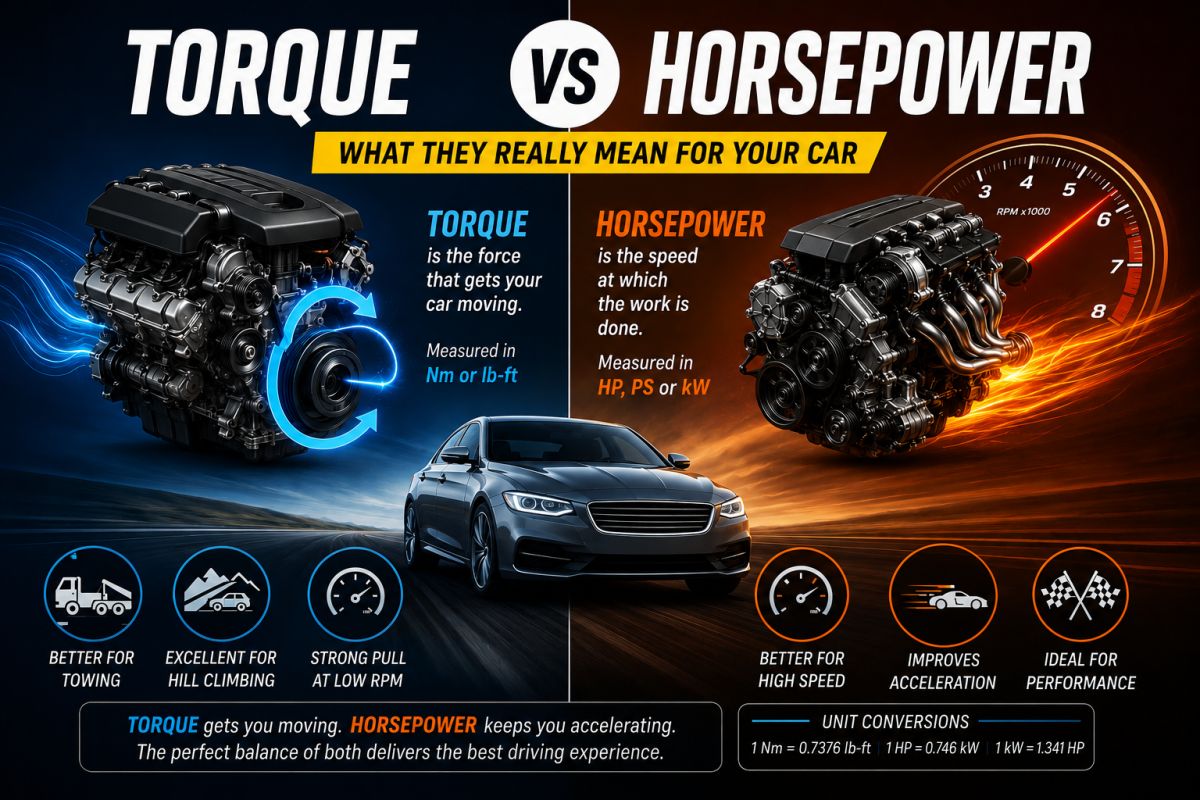
Torque is the rotational force produced by an engine or electric motor. Simply put, it is the force that turns the wheels of your vehicle.
The higher the torque, the easier it is for a vehicle to accelerate from a standstill, climb steep hills, tow heavy loads, and carry passengers.
Torque is measured in:
- Newton-meter (Nm)
- Pound-feet (lb-ft)
Conversion:
- 100 Nm = 73.76 lb-ft
- 250 Nm = 184 lb-ft
- 500 Nm = 369 lb-ft
Why Torque Matters
- Better acceleration from low speeds
- Excellent towing capability
- Improved hill climbing
- Comfortable city driving
- Less gear shifting
- More pulling power
What is Horsepower?
Horsepower is a measurement of how quickly an engine can perform work. While torque tells you how much force an engine produces, horsepower tells you how rapidly that force is delivered.
Horsepower is commonly shown as:
- HP
- BHP
- PS
- kW
Conversions:
- 1 HP = 0.746 kW
- 1 kW = 1.341 HP
- 150 HP = 112 kW
- 200 HP = 149 kW
Power and Torque Relation
Torque and horsepower are directly related.
The formula is:
Horsepower = (Torque × RPM) ÷ 5252
This means horsepower increases as engine speed (RPM) increases while torque is maintained.
Torque vs Horsepower
| Torque | Horsepower |
|---|---|
| Rotational force | Rate of doing work |
| Measured in Nm or lb-ft | Measured in HP, PS or kW |
| Important at low RPM | Important at high RPM |
| Best for towing | Best for top speed |
| Better city driving | Better highway driving |
Diesel vs Petrol Torque
Diesel engines generally produce much higher torque than petrol engines. This makes them ideal for trucks, SUVs, pickups, and vehicles that frequently carry heavy loads.
Petrol engines usually produce higher horsepower, making them more enjoyable for sporty driving and highway acceleration.
Electric Vehicle Torque
Electric motors deliver maximum torque almost instantly. This is why many electric vehicles accelerate much faster than similarly powered petrol or diesel cars.
Why Sports Cars Focus on Horsepower
Sports cars operate at high engine speeds where horsepower becomes increasingly important. High horsepower allows better top speed, faster overtaking, and superior racing performance.
Why Trucks Need Torque
Commercial trucks, buses, tractors, and heavy SUVs prioritize torque because pulling heavy loads requires tremendous rotational force rather than extreme top speed.
Torque Slip Characteristics
Torque slip characteristics describe how torque changes inside automatic transmissions and torque converters during acceleration. Torque multiplication improves vehicle launch and low-speed performance before gradually reducing as speed increases.
Real Examples
Family SUV
- 200 HP
- 420 Nm Torque
Perfect for long-distance travel and towing.
Sports Sedan
- 320 HP
- 380 Nm Torque
Excellent highway acceleration and performance driving.
Electric Hatchback
- 170 kW (228 HP)
- 310 Nm Torque
Instant acceleration due to electric motor torque.
Which One Matters More?
If you mainly drive in the city or tow heavy loads, prioritize higher torque.
If you enjoy highway driving, performance cars, or fast acceleration at higher speeds, horsepower becomes more important.
The best vehicles combine strong torque with sufficient horsepower for balanced performance.
Conclusion
Torque and horsepower are two sides of the same coin. Torque provides the force needed to move the vehicle, while horsepower determines how quickly that force can be delivered. Instead of focusing on a single specification, always evaluate both figures to understand a vehicle's true performance.

Comments
Be the first to comment on this article.
Leave a comment