
How Do Muscle Cars Do Wheelies? The Science Behind Front-Wheel Lift & Launches
Key Takeaways & Executive Summary
Muscle car wheelstands result from extreme rotational torque moments around the rear axle, governed by 4-link suspension anti-squat geometry (>100%), high Center of Gravity (CG) to Instant Center (IC) leverage, and wrinkle-wall drag slicks biting track adhesive. Here is the full physics and chassis engineering breakdown of why front wheels leave the earth.
- 1. The Fundamental Physics: Torque Equilibrium & Dynamic Weight Transfer
- 2. Suspension Geometry: Instant Center (IC) and Anti-Squat Over 100%
- 3. Drivetrain Architecture: The Transbrake & Wrinkle-Wall Slicks
Quick Navigation (Table of Contents)
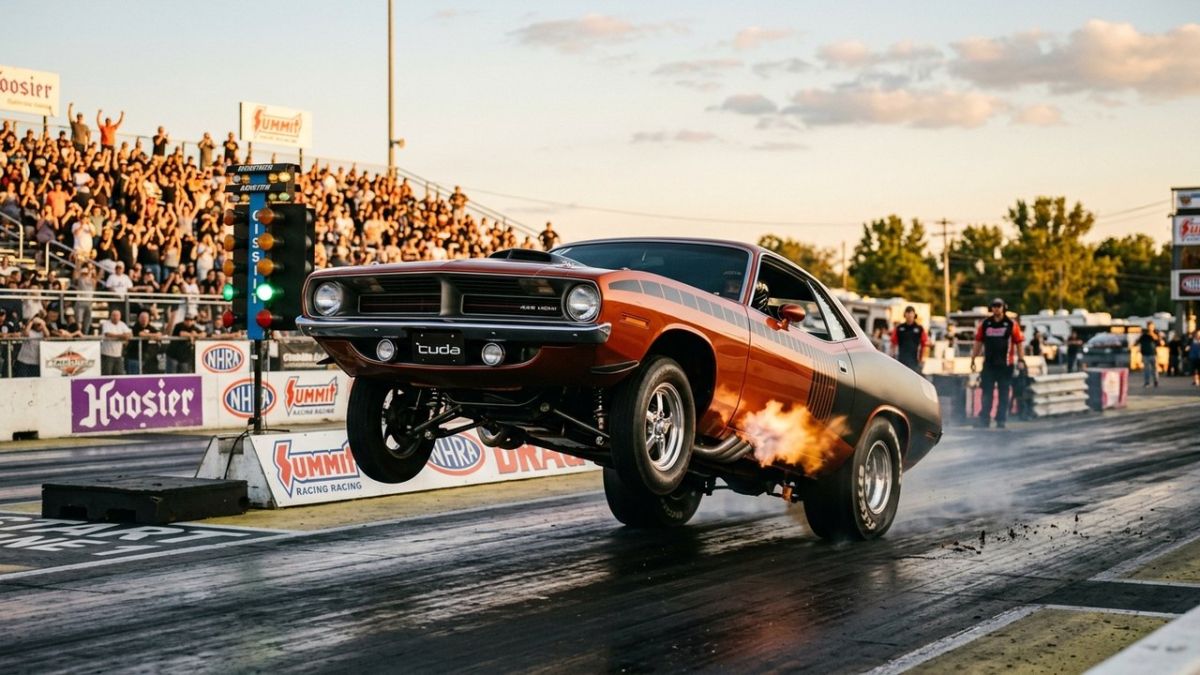
Few spectacles in motorsport are as visceral as a 1,500-horsepower vintage muscle car standing on its rear bumper at the hit of the throttle. As the staging tree turns green, the front tires hike three feet into the open air, the headers blast flame toward the sky, and the rear chassis digs violently into the tarmac. While spectators view wheelstands as pure theatrical horsepower, automotive chassis engineers view them as a strict mathematical problem in rotational torque balance, suspension geometry, and dynamic weight transfer. Here is the complete physics and engineering breakdown of how muscle cars pull front-wheel wheelies.
🚀 Core Physics & Engineering Principles
- Rotational Moment Overcome: A wheelie occurs when the forward propulsion reaction torque around the rear axle centerline exceeds the downward gravitational moment of the car's front-end weight.
- Anti-Squat Geometry > 100%: Rear 4-link suspension geometry is configured so that driving torque forces the rear axle downward into the track while jacking the chassis upward, rather than allowing the rear suspension to squat.
- Wrinkle-Wall Tire Spring Rate: Giant bias-ply drag slicks inflated to only 7–10 PSI wrinkle during initial hit, acting as high-energy mechanical torsional springs that store and explosively release launch energy.
- Transbrake Hydraulic Lock: Locking the transmission's 1st gear and reverse simultaneously allows the engine to rev to 4,500+ RPM against the stall converter before instantaneously dumping full hydraulic pressure directly into the driveshaft.
1. The Fundamental Physics: Torque Equilibrium & Dynamic Weight Transfer
A motor vehicle at rest can be modeled as a rigid body supported by two ground contact points: the front tire contact patches and the rear tire contact patches. The vehicle's mass acts through its Center of Gravity (CG), located at a specific height (h_CG) above the pavement and at a distance forward of the rear axle.
When the vehicle launches forward with horizontal acceleration (a_x), an inertial D'Alembert force acts through the center of gravity in the opposite direction. This produces a clockwise rotational moment (pitching moment) around the rear tire contact patch:
Simultaneously, the downward gravitational force of the front end creates a counter-balancing downward moment:
As long as gravitational moment exceeds pitching moment, all four wheels remain pinned to the pavement. However, if the car produces sufficient horizontal acceleration, or if the center of gravity height is elevated, pitching moment overtakes gravitational resistance. At that precise mathematical inflection point, the normal force on the front tires reaches exactly zero. Any additional torque output causes the front end to rotate upward off the pavement—initiating a wheelstand.
2. Suspension Geometry: Instant Center (IC) and Anti-Squat Over 100%
Many enthusiasts believe that a muscle car squats in the rear when doing a wheelie. In reality, excessive rear squat prevents wheelies because the collapsing coil springs and shocks absorb the launch energy rather than transferring it to chassis rotation. True wheelstand cars feature specialized 4-link or ladder-bar drag suspensions tuned with anti-squat values well above 100%.
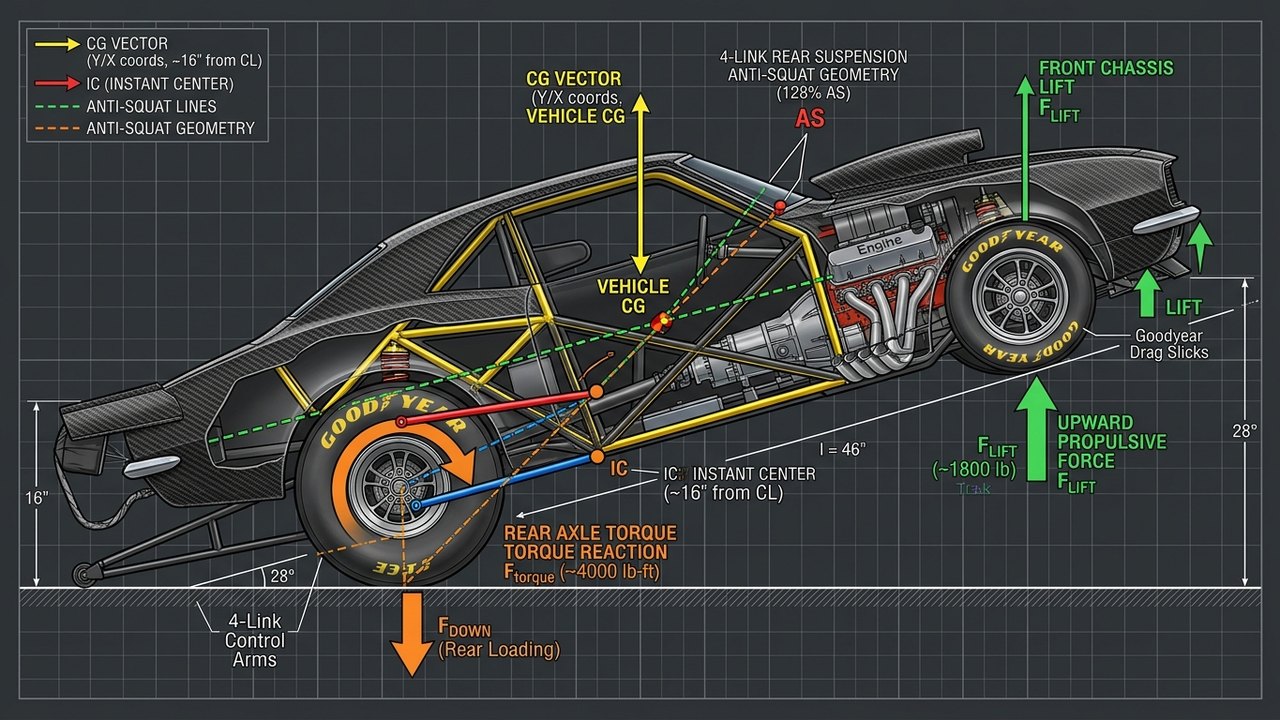
To understand how suspension geometry multiplies wheelstand physics:
- The Instant Center (IC): In a 4-link rear suspension, imaginary lines drawn through the upper and lower control links converge at a single spatial point called the Instant Center. The location of this point relative to the wheelbase and center of gravity determines how torque reacts between the solid rear axle and the chassis frame.
- The 100% Neutral Line: An imaginary line drawn from the rear tire contact patch to the intersection of the front axle centerline and the vertical center of gravity height represents the 100% Anti-Squat Neutral Line. If the Instant Center sits directly on this line, the suspension neither compresses nor extends during launch.
- Anti-Squat Over 100% (Chassis Separation): Drag suspension tuners position the 4-link bars so the Instant Center sits above the neutral line, achieving 120% to 160% anti-squat. Under power, the rotational reaction of the ring gear attempts to rotate the axle housing forward. Because the control arms are angled upward, this torque reaction violently jacks the chassis upward while slamming the rear tires down into the track. This mechanical leverage lifts the front suspension to its upper limits within milliseconds.
3. Drivetrain Architecture: The Transbrake & Wrinkle-Wall Slicks
Pure horsepower is insufficient to produce a wheelie without extreme instantaneous torque shock. A car with 1,200 horsepower that rolls smoothly into the throttle will merely accelerate rapidly down the track. Front-wheel lift demands an explosive, square-wave torque spike delivered in less than 20 milliseconds.
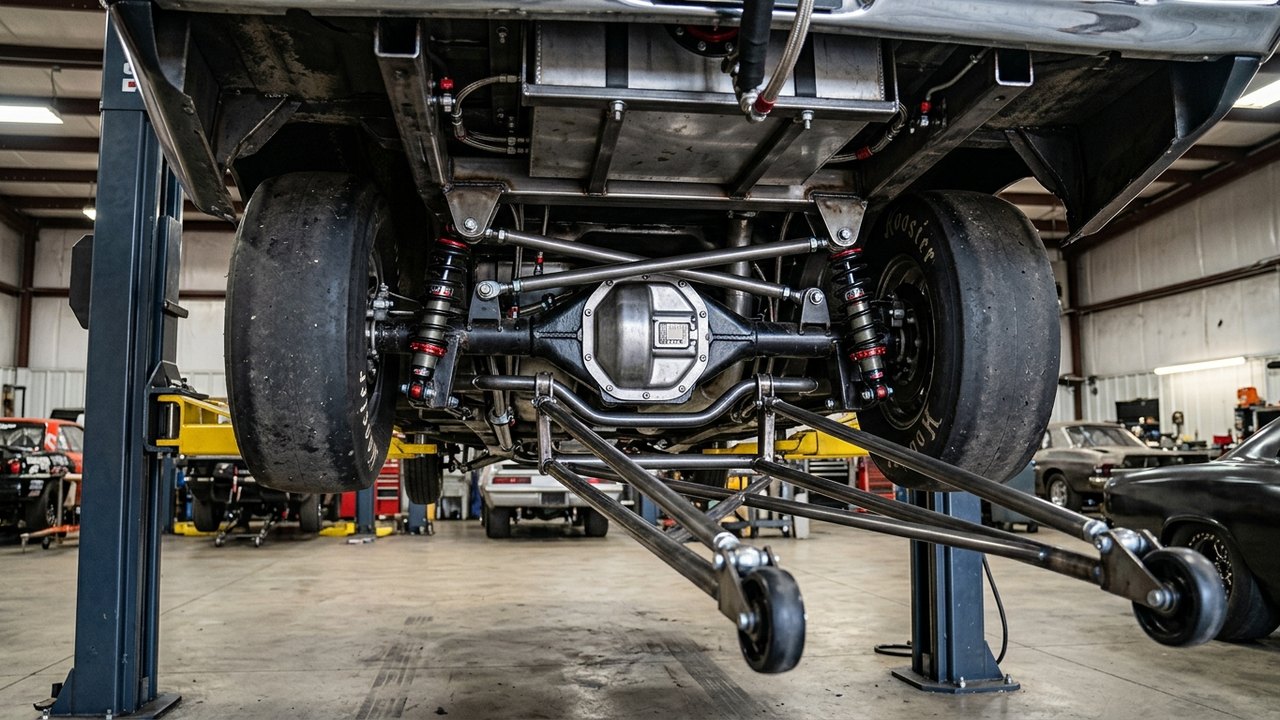
The dedicated drag racing hardware that creates this violent launch includes:
- The Transbrake Valve Body: In competition automatic transmissions (like a GM TH400, Powerglide, or Chrysler 727), a transbrake utilizes an electric solenoid to engage the first-gear clutch pack and the reverse clutch pack simultaneously. This mechanically binds the transmission output shaft, locking the car stationary on the starting line while the driver floors the accelerator. The engine revs against a high-stall torque converter (4,000 to 5,500 RPM), storing massive kinetic energy inside the rotating flexplate and torque converter fluid. The instant the driver releases the steering-wheel transbrake button, reverse dumps in under 15 milliseconds, releasing the stored energy directly into the driveshaft like a sledgehammer strike.
- Wrinkle-Wall Bias-Ply Drag Slicks: Radial street tires have stiff steel-belted sidewalls that slip under sudden torque shock. True drag slicks utilize flexible nylon bias plies inflated to only 6.5 to 9.5 PSI. When the transbrake releases, the wheel rim spins inside the tire carcass, physically wrinkling the sidewalls. This wrinkling cushions the initial shock so the tread does not break traction, effectively storing rotational energy and standing up the tire diameter, raising the rear axle centerline and launching the car upward.
- VHT Track Prep / PJ1 TrackBite: A wheelie requires extraordinary surface grip. Drag strips spray high-tack resin compounds (commonly known as VHT or TrackBite) onto the concrete launch pad. The coefficient of friction on a prepped drag surface exceeds 1.8 to 2.2, compared to just 0.8 on normal dry highway asphalt. Without this sticky track surface, the tires would simply spin.
4. Technical Comparison: Street Muscle Car vs. Pro Wheelstander Drag Spec
Comparing a production street muscle car with a purpose-built drag machine highlights why regular street cars do burnouts, while drag cars lift the sky.
| Engineering Parameter | Stock Street Muscle (Dodge Hellcat) | Bracket / Super Stock Drag Car | Pro Mod / Exhibition Wheelstander |
|---|---|---|---|
| Horsepower & Torque | 717 HP / 656 lb-ft | 900–1,200 HP / 850+ lb-ft | 1,500–2,500+ HP / 1,400+ lb-ft |
| Rear Suspension Type | Independent Rear Suspension (IRS) | Solid Axle 4-Link with Panhard Bar | Solid Axle Top Sportsman 4-Link / Ladder Bar |
| Anti-Squat Percentage | 50%–70% (Squats under power) | 120%–140% (Chassis separates) | 150%–180% (Extreme upward lift) |
| Tire Type & Pressure | DOT Radial / 32 PSI | 29.5x10.5W Drag Slick / 8.5 PSI | 34.5x17.0 Pro Drag Slick / 6.0 PSI |
| Launch Mechanism | Foot Brake / Launch Assist Mode | Electric Transbrake Solenoid | Air-Assisted Pneumatic Transbrake |
| Front Wheel Lift Behavior | 0 inches (Front suspension extends only) | 12–24 inches (Controlled power wheelie) | 36–60+ inches (Full bumper-scraper) |
5. Why Serious Drag Racers Actually Try to Prevent Giant Wheelies
While drag racing fans cheer wildly when a muscle car points its radiator toward the clouds, the driver behind the wheel is often gritting their teeth. In serious drag racing, massive wheelies are the enemy of fast elapsed times (ET).
- Wasted Kinetic Energy: Every foot-pound of energy expended lifting a 3,200-pound vehicle vertically against earth's gravity is energy that is NOT accelerating the car horizontally down the quarter-mile. A car that pulls a massive 4-foot wheelie will consistently run a slower 60-foot time than the same car launching flat with front tires barely skimming the pavement.
- Total Loss of Steering Control: When the front tires leave the track, the driver loses all steering capability. If the car begins drifting toward the guardrail or crossing the centerline due to unequal tire rollouts or engine torque steer, the driver cannot steer back. The only recourse is to abruptly lift off the throttle, which ruins the pass.
- Violent Oil Pan and Chassis Destruction: When the driver lifts off the throttle at the apex of a wheelstand, the heavy cast-iron or aluminum engine block crashes back down onto the concrete with multi-G impact. This violent slam frequently bends front tubular K-members, shatters steering racks, cracks transmission bellhousings, and splits oil pans open.
- Engine Oil Starvation: At a 45-degree pitch angle, engine oil sloshes violently to the very rear of the oil pan, exposing the oil pickup tube to air. At 7,000 RPM, running dry for even 0.8 seconds can spin connecting rod bearings and cause catastrophic engine failure.
To tame wheelstands, racers install chromoly wheelie bars. Wheelie bars limit chassis pitch rotation to a predetermined angle (usually 8 to 12 inches of front tire lift), allowing maximum rear tire loading without allowing the car to climb into the danger zone.
6. Frequently Asked Questions (FAQ)
Can a stock street car do a wheelie on regular pavement?
Virtually never. Production street cars are engineered with soft independent rear suspensions that squat under acceleration, low centers of gravity, and hard-compound street radial tires. On unprepared public asphalt, even a 1,000-horsepower street car will simply break traction and spin its rear tires rather than generating the 1.8+ friction coefficient needed to lift the front wheels.
How much horsepower is actually needed to pull a wheelie?
Horsepower is less critical than torque multiplication, suspension geometry, and vehicle weight distribution. With a properly dialed 4-link rear suspension (140% anti-squat), loose 90/10 front drag shocks, a short wheelbase, and sticky slicks on a prepped track, cars with as little as 450 to 500 horsepower can lift their front wheels off the ground.
What are 90/10 front drag shocks and how do they help wheelies?
90/10 shocks are specialized drag racing front dampers with asymmetric valving: 90% resistance on compression (bump) and only 10% resistance on rebound (extension). When the car launches, the loose 10% rebound allows the front suspension springs to instantly unload and push the front body upward without hydraulic damping resistance, transferring maximum weight to the rear tires.
What does a transbrake do in an automatic drag car?
A transbrake is an electro-hydraulic valve body modification that locks first gear and reverse gear simultaneously inside an automatic transmission. This binds the transmission internally, preventing the driveshaft from turning. The driver can hold the engine at full throttle (against the torque converter stall speed) without rolling past the staging beams, releasing full torque in milliseconds when the solenoid button is released.
Why do mid-engine cars rarely do wheelies compared to front-engine muscle cars?
While mid-engine cars have substantial rearward weight bias (often 40/60 front-to-rear), they typically feature an extremely low center of gravity, long wheelbases relative to engine placement, and independent rear suspension geometry engineered with high anti-dive and anti-squat roll centers designed for flat cornering rather than upward rotational chassis leverage.
Download the Free 2026 Car Buying & EV Checklist
Avoid expensive dealership markups and EV battery pitfalls with our verified 15-point inspection checklist.
Instant digital access. No spam, unsubscribe anytime.


Comments
Be the first to comment on this article.
Leave a comment