
Launch Control Explained: How Supercars Go From 0–60 So Fast Without Spinning the Tires
Key Takeaways & Executive Summary
Supercar launch control systems combine high-frequency wheel speed sensors, dual-clutch micro-slip modulation, and dynamic engine torque cutting to achieve 0–60 mph sprints under 2.5 seconds without catastrophic wheelspin. Here is the complete engineering breakdown of torque management, anti-squat weight transfer, and transmission launch algorithms.
- 1. The Physics of Traction: Peak Static Grip vs. Kinetic Friction
- 2. Powertrain Hardware: Dual-Clutch Packs & Sensor Closed-Loop Architecture
- 3. Step-by-Step Launch Sequence: From Staging to Full Boost Clutches Out
Quick Navigation (Table of Contents)
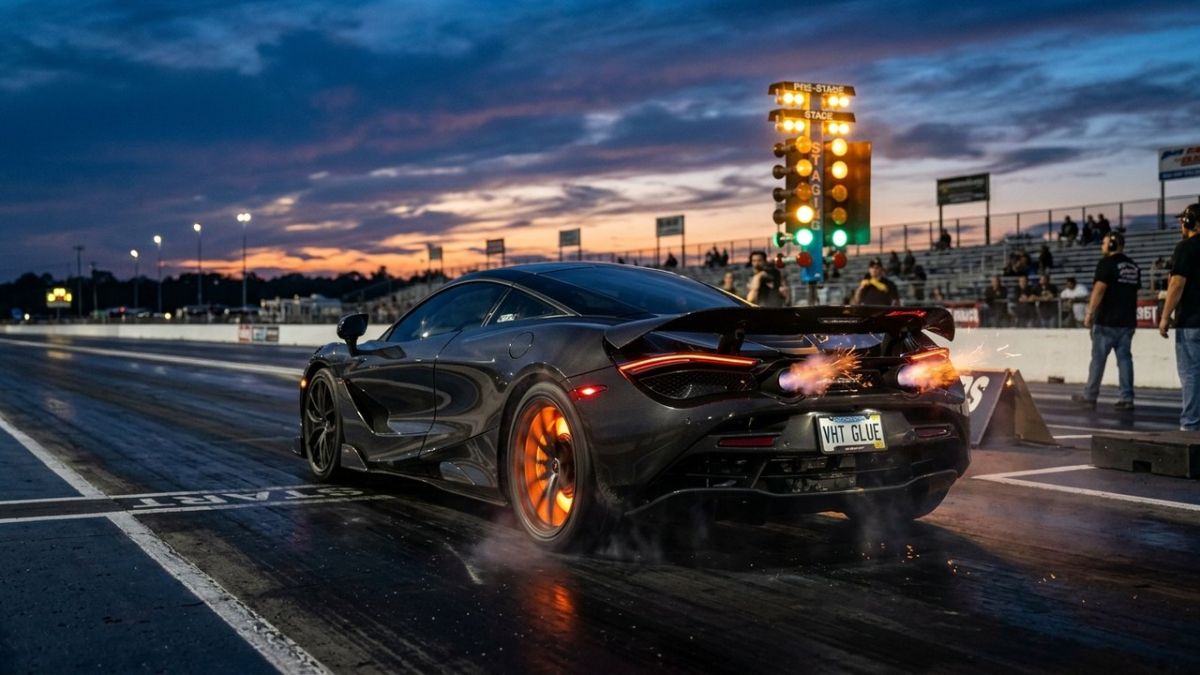
Standing on the brake pedal of a 700-horsepower twin-turbo supercar while pinning the throttle to the floor feels counter-intuitive to every driving instinct. Yet, the moment the driver releases the brake, the machine rockets from 0 to 60 mph in under 2.5 seconds without a single screech of uncontrolled tire smoke. How can modern supercars harness hundreds of pound-feet of instantaneous torque from a dead standstill without instantly vaporizing their high-performance rubber? The secret lies in automated launch control—a masterpiece of closed-loop powertrain calibration, high-speed sensor fusion, and multi-plate clutch thermodynamics.
⚡ Key Engineering Takeaways
- Target Slip Ratio: Launch control does not eliminate wheelspin entirely; it regulates tires within an optimal 10% to 15% longitudinal slip window where friction coefficient (µ) peaks.
- Sub-Millisecond Feedback: Wheel speed sensors monitor angular velocity at 1,000 Hz, allowing the Engine Control Unit (ECU) and Transmission Control Module (TCM) to adjust torque hundreds of times per second.
- Clutch Modulation vs. Ignition Cut: Systems balance dual-clutch (DCT) hydraulic pressure slipping with rapid ignition timing retarding (-15° to -25° ATDC) and cylinder fuel suppression.
- AWD Dynamic Load Shifting: Electronically controlled center differentials divert up to 70% of initial launch torque to the rear axle to capitalize on dynamic weight transfer.
1. The Physics of Traction: Peak Static Grip vs. Kinetic Friction
To understand launch control, one must first dismantle a common misconception: maximum acceleration does not occur with zero wheelspin, nor does it occur with wild tire burnout. It occurs precisely at the boundary where rubber micro-deforms into the microscopic crevices of the road surface.
Tire engineers quantify tire traction using the longitudinal slip ratio (S), defined as:
When a tire is rolling without power, slip is 0%. When a tire is spinning uncontrollably while the car sits stationary, slip is 100%. Peak tractive effort (coefficient of friction µ) does not occur at 0% slip. Modern ultra-high-performance (UHP) summer tires and semi-slick track tires achieve their maximum friction coefficient between 10% and 15% slip. In this narrow window, the outer tread blocks undergo maximum mechanical interlocking with the road texture without shearing off into microscopic liquefied particles.
If the powertrain delivers even 5% too much torque, the tires cross the peak of the friction curve into kinetic (sliding) friction, where grip drops precipitously by 20% to 40%. The tires overheat, generate blue-white smoke, and the vehicle bogs down. Launch control's singular mission is to hold the tires exactly at the absolute apex of this friction curve throughout first and second gear.
2. Powertrain Hardware: Dual-Clutch Packs & Sensor Closed-Loop Architecture
Human drivers using a traditional manual clutch pedal cannot compete with automated launch software because the human nervous system has a neuromuscular response latency of approximately 150 to 200 milliseconds. By contrast, a supercar's Transmission Control Module (TCM) and Engine Control Unit (ECU) communicate across a high-speed CAN-FD or automotive Ethernet bus with cycle frequencies under 1 millisecond.
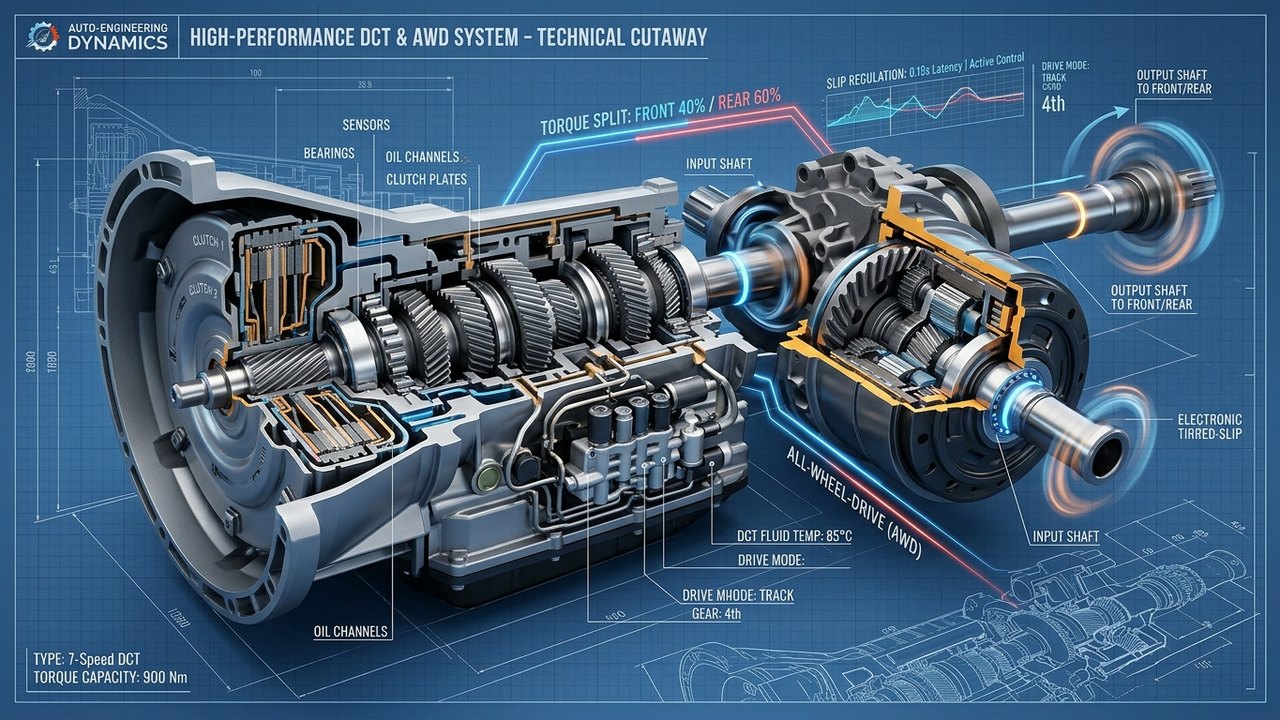
The core mechanical hardware responsible for executing launch control includes:
- Dual-Clutch Transmission (DCT) Wet Clutch Packs: Unlike a dry clutch plate that rapidly glazes under severe slippage, wet clutches are bathed in circulating high-flow automatic transmission fluid. Proportional electro-hydraulic solenoid valves command clutch clamp pressure with millibar precision, purposefully allowing the odd-gear clutch pack to slip for 0.4 to 0.8 seconds while holding the engine at peak torque RPM.
- Hall-Effect Wheel Speed Sensors: Positioned at all four wheel hubs, multi-pole magnetic tone rings read rotational velocity at microsecond intervals. The ECU immediately calculates wheel acceleration; if any driven wheel begins accelerating faster than the vehicle's true chassis acceleration (measured by 6-axis IMU inertial sensors), torque cut commands fire instantly.
- Drive-by-Wire & Electronic Wastegates: In turbocharged platforms (such as Porsche 911 Turbo S or McLaren 750S), the ECU commands the electronic wastegates shut to build boost pressure while holding stationary, pre-compressing air inside the intake plenum before the vehicle even moves.
3. Step-by-Step Launch Sequence: From Staging to Full Boost Clutches Out
Initiating launch control requires an explicit electronic handshake between the driver, chassis stability systems, and drivetrain controllers. Modern manufacturers deliberately require a specific cockpit choreography to prevent accidental engagement in public traffic.
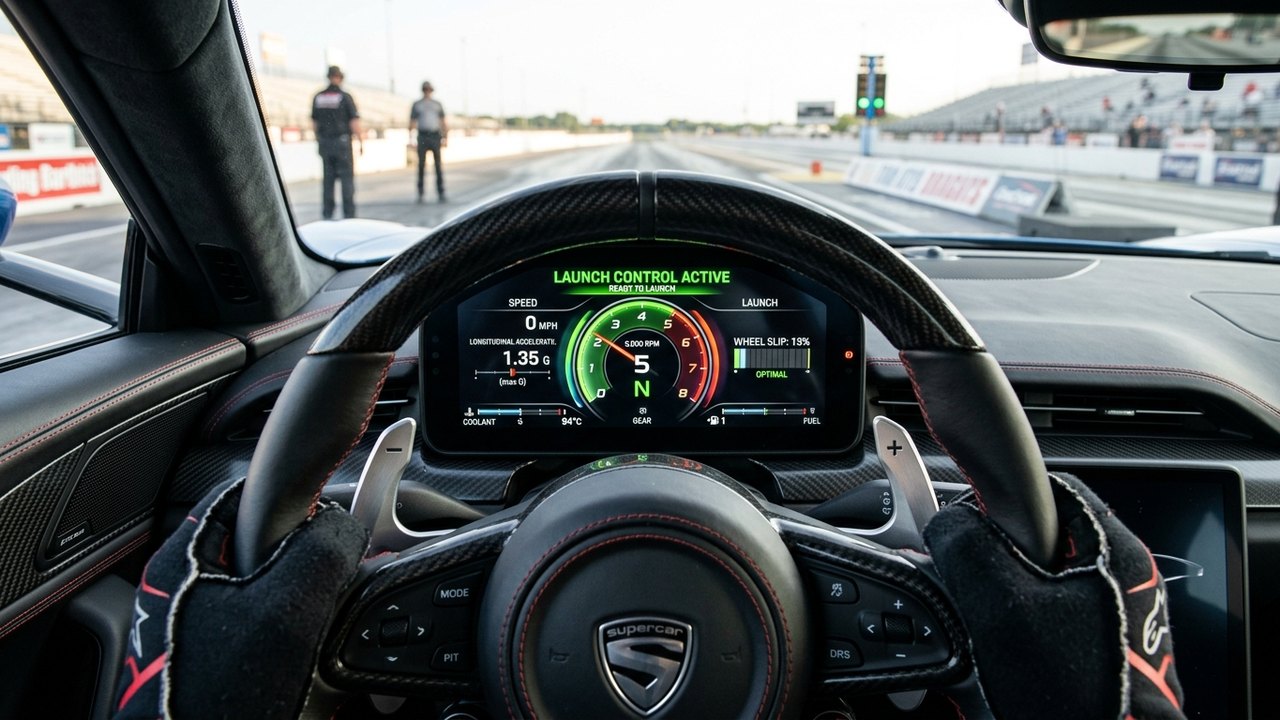
Here is the exact millisecond-by-millisecond sequence of events during a supercar launch:
- Staging & Safety Checks: The driver toggles into Track/Corsa/Sport+ mode and sets stability control to Dynamic/ESC Sport. Steering angle must be within ±2 degrees of center; coolant, engine oil, and transmission fluid temperatures must satisfy strict minimum and maximum thresholds (typically 75°C to 110°C).
- Left Foot Firmly on Brake: The driver exerts heavy hydraulic pressure on the brake pedal (exceeding 80 bar line pressure). This signals the ABS hydraulic control unit (HCU) to clamp all four calipers at maximum clamping force.
- Throttle 100% to Floor: The driver floors the accelerator pedal. Rather than revving to redline, the ECU catches the engine at a pre-calibrated launch stall speed (usually between 3,500 and 5,200 RPM depending on tire temperature and ambient barometric pressure).
- 2-Step Rev Limiting & Turbo Pre-Spool: To build boost while stationary, the ECU retards ignition timing past Top Dead Center (TDC) into negative timing. Combustion finishes inside the exhaust manifold, spooling the turbocharger turbines to positive boost pressure (up to 1.2 bar of positive manifold pressure while stationary).
- Brake Release & The Micro-Slip Phase (T+0.00s to T+0.40s): The driver dumps the left brake pedal. The TCM commands the odd clutch solenoid to ramp up clamping pressure to approximately 70% engagement within 50 milliseconds. The tires experience immediate longitudinal bite, generating over 1.2G to 1.5G of initial acceleration.
- Closed-Loop Slip Regulation (T+0.40s to T+1.20s): If rear wheel slip exceeds 15%, the ECU pulls 5 degrees of ignition timing in 4 milliseconds. As vehicle road speed matches wheel rotational speed, the clutch reaches 100% mechanical lockup, and the vehicle enters pure WOT (wide-open throttle) acceleration.
4. Technical Comparison: Launch Control Architecture Across Elite Supercars
While all launch control systems strive to maximize traction, different manufacturers implement distinct mechanical philosophies, ranging from bulletproof multi-plate wet clutches to electric motor instantaneous torque distribution.
| Supercar Model | Drivetrain & Transmission | Launch RPM | 0–60 mph (Claimed / Real) | Peak Launch G-Force | Launch Repeatability |
|---|---|---|---|---|---|
| Porsche 911 Turbo S (992) | AWD / 8-Speed PDK Wet Clutch | 5,000 RPM | 2.6s / 2.2s (with rollout) | 1.42 G | Near Unlimited (Benchmarked 50+ back-to-back) |
| Ferrari SF90 Stradale | e-AWD / 8-Speed F1 DCT + Dual Front Motors | 3,500 RPM + Instant EV Torque | 2.5s / 2.1s | 1.50 G | Moderate (High Hybrid Battery Draw) |
| McLaren 750S | RWD / 7-Speed SSG Wet Clutch | 3,800–4,500 RPM (Variable) | 2.7s / 2.5s | 1.28 G | Moderate (Rear Tire Heat Saturation) |
| Chevrolet Corvette Z06 (C8) | RWD / 8-Speed Tremec DCT | 3,500–5,000 RPM (Driver Adjustable) | 2.6s / 2.6s | 1.25 G | High (Tremec Wet Clutch Cooling) |
| Tesla Model S Plaid | Tri-Motor AWD (Direct Drive) | 0 RPM (Cheetah Adaptive Stance) | 1.99s (1-ft rollout subtracted) | 1.44 G | Thermal Battery Conditioning Required |
5. The Mechanical Toll: Thermal Shock, Axle Twist & Clutch Wear
Although launch control transforms violent launches into smooth, repeatable sprints, the laws of physics cannot be cheated. The mechanical energy generated during a launch must be managed somewhere in the vehicle's structural and fluid circuits.
- Clutch Fluid Shear Heating: During the 0.5-second micro-slip phase, the wet clutch friction plates convert hundreds of horsepower of kinetic differential into pure thermal energy. The transmission oil directly adjacent to the clutch disc surfaces can experience transient temperature spikes over 220°C (428°F). If a driver attempts multiple back-to-back launches without adequate cooling laps, the transmission fluid degrades rapidly, losing its frictional modifiers and causing clutch shudder.
- Half-Shaft & Axle Torsional Windup: The initial shock wave when the clutches bite delivers thousands of pound-feet of instantaneous wheel torque. Axle half-shafts actually twist torsionally by several degrees. To avoid catastrophic shearing, modern half-shafts are manufactured from high-nickel chromoly steel alloys with unequal diameter shafts on left and right sides to eliminate resonant wheel hop vibrations.
- Engine & Transmission Mount Deflection: The engine block experiences a severe rotational reactionary torque, attempting to twist in the opposite direction of the crankshaft rotation. High-performance supercars utilize dynamic magnetorheological or hydraulic active engine mounts that instantly stiffen to maximum rigidity during launch mode, keeping the driveline perfectly aligned.
6. Frequently Asked Questions (FAQ)
Can using launch control void a car's factory warranty?
In most modern production supercars (such as Porsche, Corvette, and BMW M cars), using the factory-equipped launch control feature does not void the warranty, provided the vehicle has passed its initial engine break-in period (typically 500 to 1,500 miles) and maintenance schedules are strictly followed. However, older sports cars (notably early Nissan GT-Rs) famously monitored launch counts and could deny transmission warranty claims if excessive launches caused mechanical failure with stability control disabled.
Why does Porsche's PDK handle dozens of launches while other DCTs overheat?
Porsche's ZF-engineered PDK (Porsche Doppelkupplungsgetriebe) utilizes an oversized, high-flow hydraulic fluid cooling circuit with dedicated transmission fluid radiators and wet clutch packs designed with massive thermal mass. Unlike road-focused dual-clutch units that use minimal fluid volumes to minimize drag, the PDK floods its clutch friction discs with high-volume cooling oil during the launch slip phase, dissipating heat before it can damage friction linings.
Can you install aftermarket launch control on a manual car?
Yes, manual vehicles can use aftermarket electronic 2-step rev limiters and standalone ECUs (such as Motec, Haltech, or Hondata) to hold a stationary launch RPM while building turbo boost. However, because a human driver must physically release the clutch pedal, slip modulation is controlled entirely by driver footwork rather than automated sub-millisecond hydraulic solenoid control.
Does launch control work on wet or icy roads?
Launch control will function on low-friction surfaces, but acceleration times will be significantly slower. The system will detect immediate wheel slippage at low RPM and aggressively slash engine torque output to maintain the target 10–15% slip ratio. In heavy rain or snow, modern launch control software often limits engine output to less than 30% of full capability to prevent vehicle yaw destabilization.
Why do electric vehicles (EVs) achieve faster 0–60 launches than combustion supercars?
Electric motors produce peak torque at zero RPM without needing to slip a mechanical clutch or build exhaust boost pressure. Furthermore, electric motor inverters can adjust electromagnetic rotor torque every 0.1 milliseconds—ten times faster than an internal combustion engine can retard ignition timing or close a throttle body—allowing nearly instantaneous traction control recovery.
Download the Free 2026 Car Buying & EV Checklist
Avoid expensive dealership markups and EV battery pitfalls with our verified 15-point inspection checklist.
Instant digital access. No spam, unsubscribe anytime.


Comments
Be the first to comment on this article.
Leave a comment