
How Do Electric Cars Work? (2026) Complete Beginner's Guide to EV Batteries, Motors, Charging & Range
Key Takeaways & Executive Summary
- What Does EV Stand For?
- How Do Electric Cars Work? The Simple Version
- The Four Key Parts of an Electric Car
Quick Navigation (Table of Contents)
Electric cars are everywhere now, but how do they actually work? If you have ever wondered what replaces the engine, where the power comes from, or how far you can really drive on a charge, this beginner's guide explains everything in plain language — no engineering degree required.
What Does EV Stand For?
EV stands for Electric Vehicle. It refers to any car powered wholly or partly by electricity stored in a battery, rather than by burning gasoline or diesel. A fully electric car — sometimes called a BEV, for Battery Electric Vehicle — runs entirely on electricity and has no gas tank at all.
How Do Electric Cars Work? The Simple Version
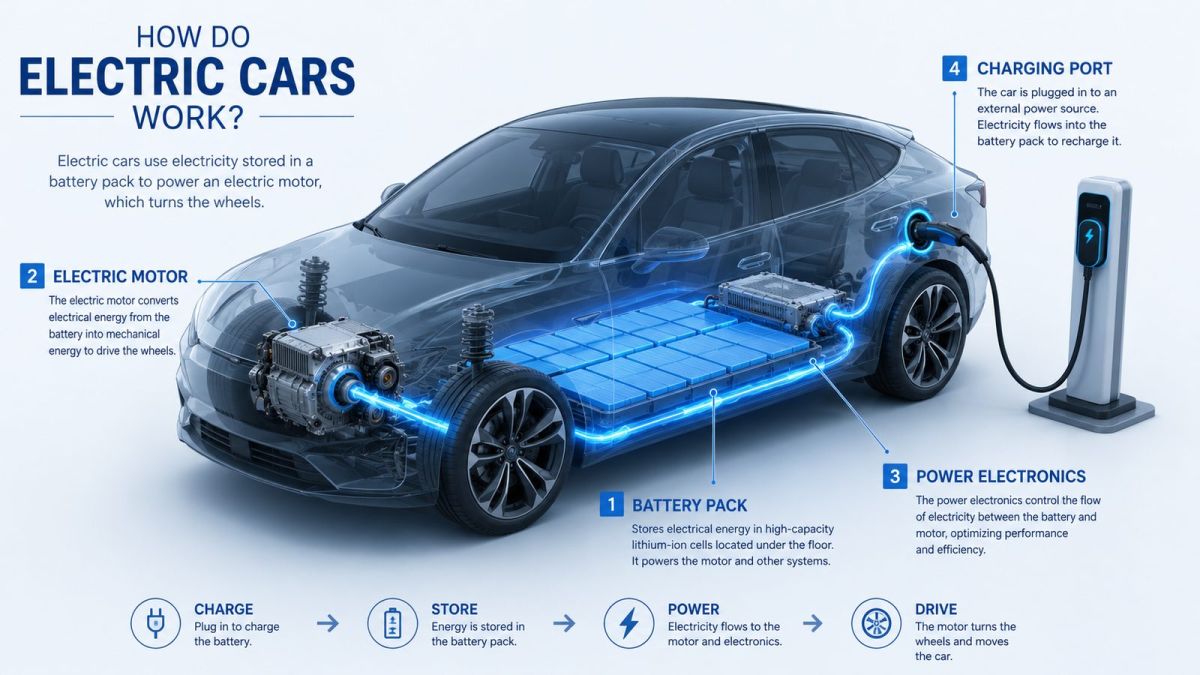
At its core, an electric car works by using electricity stored in a large battery pack to spin an electric motor, which turns the wheels. When you press the accelerator, the car's controller draws power from the battery and feeds it to the motor. Release the pedal, and the motor can actually run in reverse to slow the car and recharge the battery — a clever trick called regenerative braking. That's the whole loop: battery → controller → motor → wheels.
The Four Key Parts of an Electric Car
1. The Battery Pack
The battery is the heart of an EV. It's a large pack of lithium-ion cells — the same basic chemistry as your phone battery, just thousands of times bigger — usually mounted flat under the floor. The battery's capacity, measured in kilowatt-hours (kWh), determines how far the car can travel. A bigger battery means more range but also more weight and cost.
2. The Electric Motor
Instead of an engine with hundreds of moving parts, an EV uses one or more electric motors. Electric motors are remarkably simple, nearly silent, and deliver full power instantly — which is why even modest electric cars feel quick off the line. Many EVs place a motor on each axle to provide all-wheel drive.
3. The Controller (Power Electronics)
The controller is the brain between the battery and the motor. It converts the battery's stored energy into precisely the right amount of power the motor needs at any moment, based on how hard you press the pedal.
4. The Onboard Charger
When you plug in, the onboard charger converts electricity from the grid into the form your battery can store. This is what allows you to charge at home from a standard outlet or a dedicated wall unit. For more detailed measurements and vehicle specifications, explore our comprehensive CVT vs automatic transmission comparison.
Do Electric Vehicles Have Engines?
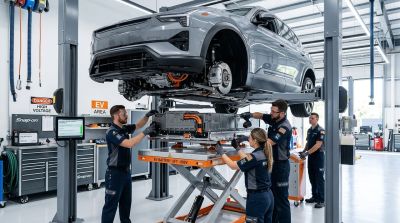
No — a fully electric car does not have an internal combustion engine, and therefore no spark plugs, oil changes, exhaust system, or transmission in the traditional sense. This is why EVs need far less routine maintenance. (Hybrids are the exception: they pair a small gas engine with an electric motor, so they do have an engine.)
What Are Electric Motors for Cars?
Electric motors for cars convert electrical energy into rotational force to drive the wheels. Most EVs use AC induction motors or permanent-magnet motors. Their big advantages over gas engines are instant torque, near-silent operation, fewer moving parts to wear out, and much higher energy efficiency — an electric motor converts around 90% of its energy into motion, versus roughly 30% for a gasoline engine.
How Do You Charge an Electric Car?
There are three main charging levels:
- Level 1: A standard household outlet. Slowest option — good for overnight top-ups.
- Level 2: A 240-volt home or public charger. Fully recharges most EVs overnight.
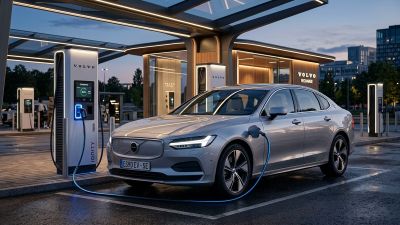
- Level 3 (DC Fast Charging): Public fast chargers that can add 100+ miles of range in 20-30 minutes.
How Far Can an Electric Car Go?
Modern electric cars typically travel between 200 and 350 miles on a full charge, depending on the battery size, driving speed, and weather. Cold temperatures and highway speeds reduce range, while city driving with lots of braking actually extends it thanks to regenerative braking.
Are Electric Cars Worth It?
For many drivers, yes. EVs cost less to fuel and maintain, deliver a smooth quiet ride, and produce zero tailpipe emissions. The main trade-offs are higher upfront cost and the need to plan around charging on longer trips. As battery prices fall and charging networks expand, those trade-offs continue to shrink.
EV vs Fuel Cost Savings Calculator
Download the Free 2026 Car Buying & EV Checklist
Avoid expensive dealership markups and EV battery pitfalls with our verified 15-point inspection checklist.
Instant digital access. No spam, unsubscribe anytime.

Comments
Be the first to comment on this article.
Leave a comment