
EV Charging Cost Explained : How Much Does It Cost to Charge an Electric Car? Best Home & Portable Chargers Guide
Key Takeaways & Executive Summary
Wondering how much it costs to charge an electric car? This complete 2026 EV charging guide explains EV charging costs, home vs public charging prices, charging time, kWh calculation formula, Level 1, Level 2 and DC fast chargers, installation costs, and the best home and portable EV chargers for every budget.
- How Much Does It Cost to Charge an Electric Car?
- Country Examples
- Home Charging vs Public Charging
Quick Navigation (Table of Contents)
One of the biggest questions people ask before buying an electric vehicle (EV) is:
"How much does it cost to charge an electric car?"
The answer depends on several factors, including electricity prices, battery size, charging location, and charging efficiency. In this guide, you'll learn how to calculate EV charging costs using a simple formula, compare home and public charging, and discover the best home and portable EV chargers.
How Much Does It Cost to Charge an Electric Car?
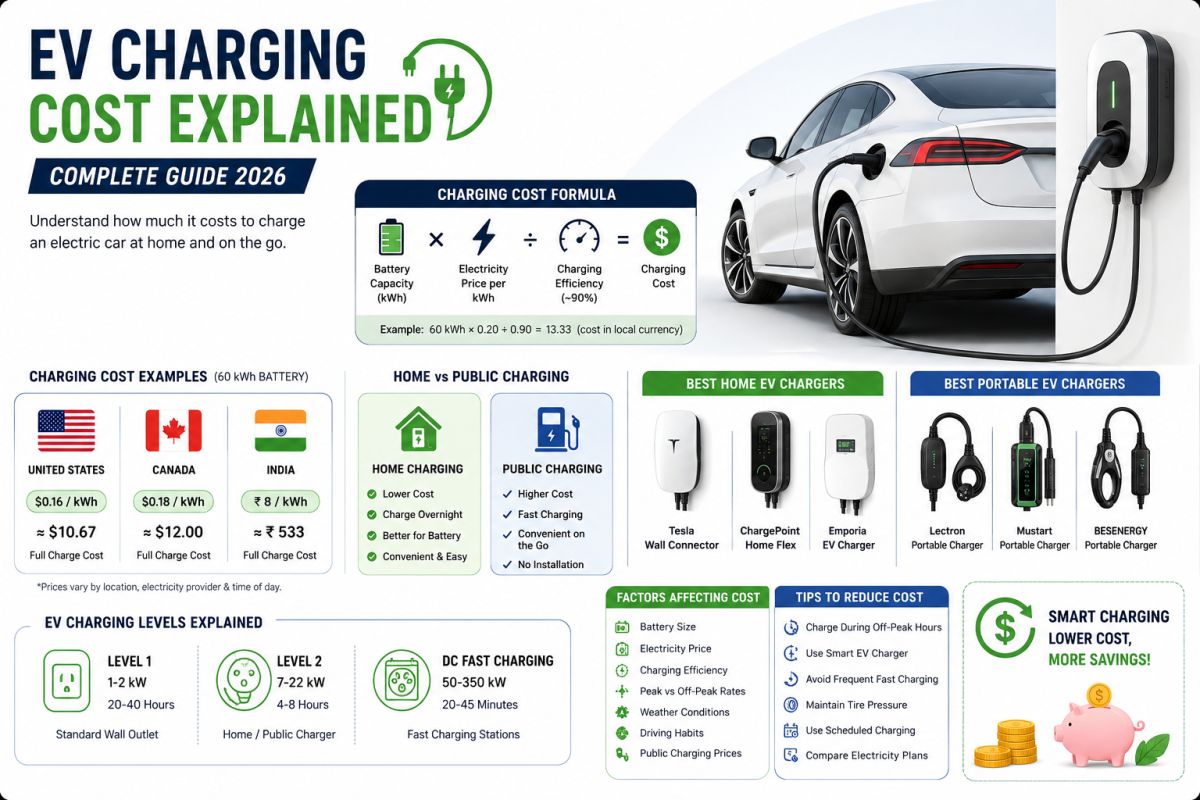
The easiest way to estimate charging cost is using this universal formula:
Charging Cost =
Battery Capacity (kWh)
×
Electricity Price per kWh
÷
Charging Efficiency
Most chargers operate at around 90-95% efficiency.
Example:
- Battery Size = 60 kWh
- Electricity Price = 0.20 per kWh
- Efficiency = 90% (0.90)
60 × 0.20 ÷ 0.90
= 13.33
Charging a 60 kWh EV would cost approximately 13.33 units of local currency.
Country Examples
| Country | Typical Home Electricity Price | Approx Cost for 60 kWh Battery |
|---|---|---|
| United States | 0.16/kWh | ≈ 10.67 |
| Canada | 0.18/kWh | ≈ 12.00 |
| India | ₹8/kWh | ≈ ₹533 |
Actual charging costs vary by state, province, city, and utility provider.
Home Charging vs Public Charging
| Home Charging | Public Charging |
|---|---|
| Lower electricity cost | Usually more expensive |
| Charge overnight | Fast charging available |
| Better battery health | Convenient during travel |
| Requires charger installation | No installation needed |
If you drive daily, home charging is generally the most economical option.
Level 1 vs Level 2 vs DC Fast Charging
| Type | Power | Charging Time |
|---|---|---|
| Level 1 | 1-2 kW | 20-40 hours |
| Level 2 | 7-22 kW | 4-8 hours |
| DC Fast Charger | 50-350 kW | 20-45 minutes |
Best Home EV Chargers
1. Tesla Wall Connector
- Fast Level 2 charging
- Wi-Fi updates
- Suitable for Tesla owners
2. ChargePoint Home Flex
- Smart app
- Flexible amperage
- Energy monitoring
3. Emporia EV Charger
- Affordable
- Wi-Fi enabled
- Excellent value
Best Portable EV Chargers
Lectron Portable EV Charger
- Easy to carry
- Ideal for emergencies
- Works with most EVs
Mustart Portable Charger
- Durable cable
- Fast Level 2 charging
- Travel-friendly
BESENERGY Portable Charger
- Compact
- Affordable
- Multiple plug options
Charging Socket Price
The cost of installing a charging socket depends on:
- Electrical wiring
- Breaker upgrades
- Installation labor
- Socket type
- Country regulations
Most homeowners should expect installation costs to be separate from the charger itself.
Factors That Affect EV Charging Cost
- Battery size
- Electricity tariff
- Charging efficiency
- Peak vs off-peak pricing
- Weather conditions
- Battery condition
- Public charging network pricing
Tips to Reduce Charging Costs
- Charge overnight during off-peak hours.
- Install a smart Level 2 charger.
- Avoid frequent DC fast charging.
- Maintain tire pressure for better efficiency.
- Use scheduled charging features.
- Compare electricity plans.
Should You Buy a Portable EV Charger?
A portable EV charger is recommended if you:
- Travel frequently
- Visit remote locations
- Need emergency charging
- Use multiple charging locations
For everyday charging, a dedicated home wall charger offers better convenience and faster charging speeds.
Final Thoughts
Calculating EV charging costs is simple when you know your battery capacity and electricity price. Home charging remains the most affordable solution for most drivers, while portable chargers provide flexibility during travel. Choosing the right charger and charging at off-peak hours can significantly reduce long-term ownership costs.
EV vs Fuel Cost Savings Calculator
Download the Free 2026 Car Buying & EV Checklist
Avoid expensive dealership markups and EV battery pitfalls with our verified 15-point inspection checklist.
Instant digital access. No spam, unsubscribe anytime.

Comments
Be the first to comment on this article.
Leave a comment