
2WD vs 4WD vs AWD: What Is the Difference and Which Drive System Is Best?
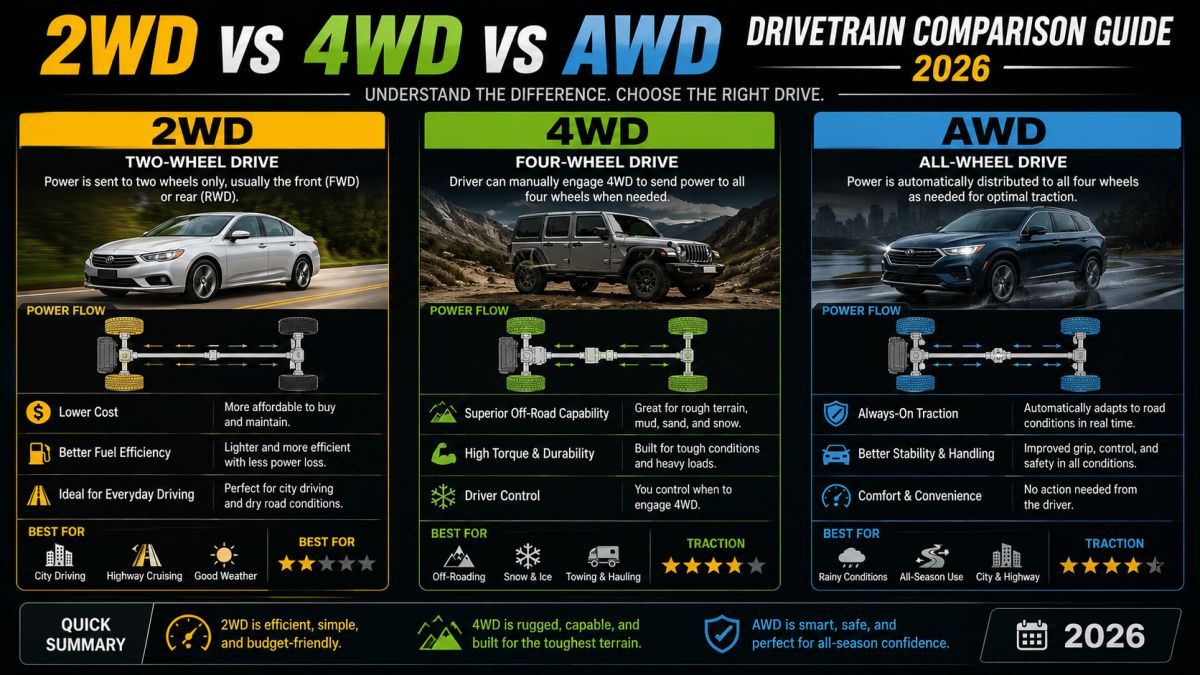
Key Takeaways & Executive Summary
Understand the difference between 2WD, 4WD, and AWD systems in this complete 2026 guide. Learn how front-wheel drive, rear-wheel drive, four-wheel drive, and all-wheel drive work, their advantages, disadvantages, performance, and which drivetrain is best for your driving needs.
- What Is a Drivetrain System?
- What Does 2WD Mean?
- Types of 2WD Systems
Quick Navigation (Table of Contents)
When choosing a car, most buyers focus on engine power, mileage, and features, but the drivetrain system is equally important. The drive system determines how engine power reaches the wheels and directly affects traction, handling, fuel efficiency, and performance.
The most common drivetrain systems are 2WD, 4WD, and AWD. Understanding the difference between these systems helps you choose the right vehicle for city driving, highways, snowy roads, rainy conditions, or off-road adventures.
What Is a Drivetrain System?
A drivetrain system is the mechanism that transfers power from the engine to the wheels. Depending on the design, power can be sent to the front wheels, rear wheels, or all four wheels.
What Does 2WD Mean?
2WD stands for Two-Wheel Drive. In a 2WD vehicle, engine power is delivered to only two wheels instead of all four.
Most passenger vehicles use 2WD because it provides good fuel efficiency, lower maintenance costs, and sufficient traction for normal driving conditions.
Types of 2WD Systems
Front-Wheel Drive (FWD)
Front-wheel drive sends engine power to the front wheels. It is one of the most common drivetrain layouts used in modern cars.
Advantages of Front Engine Front Wheel Drive
- Better fuel efficiency
- Lower manufacturing cost
- More interior cabin space
- Good traction during normal conditions
- Easier maintenance
Disadvantages of Front-Wheel Drive
- Less performance during aggressive driving
- Front tyres handle both steering and power delivery
- Limited off-road capability
Rear-Wheel Drive (RWD)
Rear-wheel drive, also known as back wheel drive cars, sends engine power to the rear wheels.
Rear-wheel drive is commonly used in sports cars, luxury vehicles, and performance-focused vehicles because it provides better handling balance.
Advantages of Rear-Wheel Drive Cars
- Better weight distribution
- Improved handling performance
- Better acceleration
- Suitable for powerful engines
- Preferred for performance driving
Disadvantages of Rear-Wheel Drive Cars
- Less traction on slippery roads
- Higher complexity
- Can be difficult in snow without proper tyres
What Is 4WD?
4WD or Four-Wheel Drive is a system that sends power to all four wheels, usually through a selectable drivetrain system.
4WD systems are designed for challenging conditions such as off-road driving, mud, sand, rocks, and extreme terrain.
Advantages of 4WD
- Excellent off-road capability
- Better traction on difficult surfaces
- Strong performance in mud and rough terrain
- Suitable for adventure vehicles
Disadvantages of 4WD
- Higher fuel consumption
- More expensive maintenance
- Additional weight
- Usually unnecessary for normal city driving
What Is AWD?
AWD stands for All-Wheel Drive. AWD automatically distributes power between all four wheels based on road conditions and traction requirements.
Unlike traditional 4WD systems, AWD is designed for everyday driving and automatically improves grip when needed.
Advantages of AWD
- Better traction in rain and snow
- Improved cornering stability
- Automatic power distribution
- Good for changing road conditions
Disadvantages of AWD
- Higher fuel consumption than 2WD
- More expensive maintenance
- Additional mechanical complexity
2WD vs 4WD vs AWD: Quick Comparison
| Feature | 2WD | 4WD | AWD |
|---|---|---|---|
| Power Delivery | Two wheels | All four wheels | All four wheels when needed |
| Best For | City and highway driving | Off-road conditions | Rain, snow, mixed conditions |
| Fuel Efficiency | Best | Lowest | Moderate |
| Maintenance Cost | Lower | Higher | Higher |
| Traction | Normal conditions | Excellent | Very good |
Difference Between 2WD and 4WD
The main difference between 2WD and 4WD is the number of powered wheels. A 2WD vehicle sends power to only two wheels, while a 4WD vehicle powers all four wheels for improved traction.
- 2WD is better for fuel efficiency and daily driving.
- 4WD is better for off-road and extreme terrain.
AWD vs 4WD: What Is the Difference?
Both AWD and 4WD provide power to all four wheels, but they are designed for different purposes.
- AWD: Automatically manages power distribution and is ideal for changing weather conditions.
- 4WD: Usually provides selectable modes and is designed for serious off-road use.
Which Drive System Is Best for You?
Choose 2WD If:
- You mainly drive in cities
- You want better fuel economy
- You want lower maintenance costs
- You drive on normal roads
Choose AWD If:
- You experience rain or snow frequently
- You want extra road grip
- You drive in changing conditions
Choose 4WD If:
- You drive off-road regularly
- You travel on mud, sand, or rough terrain
- You need maximum traction capability
Does Climate Affect the Best Drive System?
Weather and road conditions play an important role when choosing a drivetrain. AWD can provide extra confidence in areas with frequent rain or snow, while 4WD is more suitable for extreme terrain.
In normal dry road conditions, a well-designed 2WD vehicle with quality tyres can provide excellent performance and efficiency.
Conclusion
There is no single best drivetrain system for every driver. 2WD offers efficiency and affordability, AWD provides confidence in changing weather, and 4WD delivers maximum capability for off-road environments.
Choosing between 2WD, 4WD, and AWD depends on your driving habits, climate, road conditions, and performance requirements.
Frequently Asked Questions
What is the difference between 2WD, 4WD and AWD?
2WD powers two wheels, 4WD powers all four wheels mainly for off-road use, and AWD automatically distributes power to all wheels when required.
Are rear-wheel drive cars better?
Rear-wheel drive cars provide better handling balance and performance, especially in powerful vehicles, but they may require more care on slippery roads.
Which is better AWD or 4WD?
AWD is better for everyday driving and changing weather conditions, while 4WD is better for serious off-road driving.
Is 2WD enough for daily driving?
Yes, 2WD is suitable for most city and highway driving conditions and offers better fuel efficiency.
Does AWD use more fuel than 2WD?
Yes, AWD systems usually consume slightly more fuel because they add weight and mechanical complexity.
What are the advantages of front engine front wheel drive?
Front engine front-wheel drive provides better fuel efficiency, more cabin space, lower cost, and good traction in normal driving conditions.
EV vs Fuel Cost Savings Calculator
Download the Free 2026 Car Buying & EV Checklist
Avoid expensive dealership markups and EV battery pitfalls with our verified 15-point inspection checklist.
Instant digital access. No spam, unsubscribe anytime.



Comments
Be the first to comment on this article.
Leave a comment