
CVT vs Automatic Transmission: Which Is Better? Complete Comparison Guide (2026)
Key Takeaways & Executive Summary
- What Is an Automatic Transmission?
- What Is CVT Transmission?
- CVT vs Automatic Transmission: Quick Comparison
Quick Navigation (Table of Contents)
Choosing the right transmission is an important decision when buying a car. Modern vehicles come with advanced gearbox technologies such as CVT and traditional automatic transmissions.
Many drivers search for CVT transmission vs automatic because both provide automatic driving convenience but deliver a different driving experience. Understanding their differences helps you choose the right vehicle based on fuel efficiency, performance, comfort, and maintenance.
What Is an Automatic Transmission?
An automatic transmission is a gearbox system that automatically changes gears without requiring the driver to manually operate a clutch or shift gears.
Traditional automatic transmissions use fixed gear ratios and a torque converter to transfer power from the engine to the wheels.
How Does an Automatic Transmission Work?
- Uses multiple fixed gears
- Uses a torque converter instead of a manual clutch
- Automatically shifts gears according to driving conditions
- Provides smooth acceleration and comfortable driving
What Is CVT Transmission?
CVT stands for Continuously Variable Transmission. Unlike traditional automatic gearboxes, CVT does not use fixed gears. Instead, it uses a belt and pulley system to provide a continuous range of gear ratios.
The main goal of CVT technology is to keep the engine running at the most efficient RPM level, improving fuel economy and providing smooth power delivery.
CVT Full Form
CVT full form: Continuously Variable Transmission.
How Does CVT Work?
- Uses variable pulleys and a belt or chain system
- Automatically adjusts gear ratio continuously
- Keeps engine RPM optimized
- Provides smooth acceleration without noticeable gear shifts
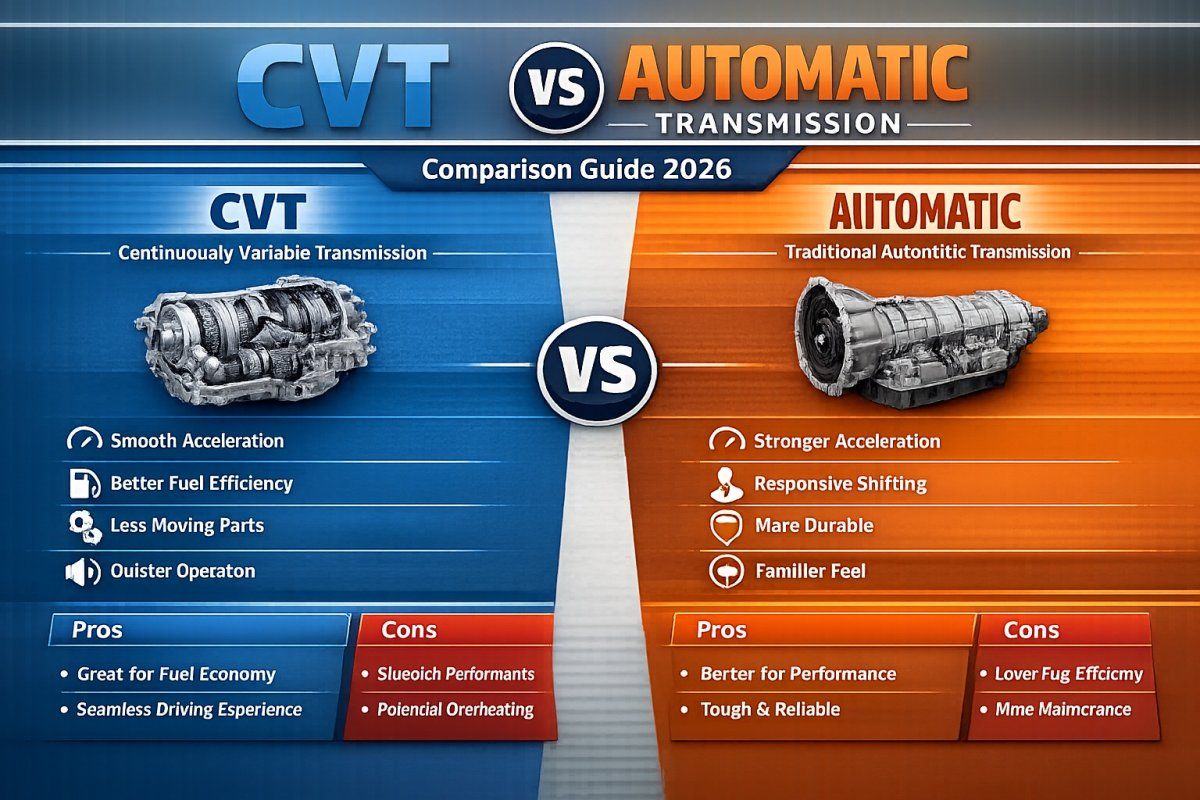
CVT vs Automatic Transmission: Quick Comparison
| Feature | CVT Transmission | Automatic Transmission |
|---|---|---|
| Gear System | No fixed gears, continuous ratio adjustment | Uses fixed gear ratios |
| Driving Feel | Very smooth and consistent | Traditional shifting experience |
| Fuel Efficiency | Usually better in small cars | Depends on transmission type and vehicle |
| Performance | Best for comfort and efficiency | Better for powerful driving and towing |
| Maintenance | Requires specific CVT fluid and service | Generally easier to service |
| Driving Experience | Smooth but less sporty | More engaging gear changes |
Difference Between CVT and Automatic Transmission
The main difference between CVT and automatic transmission is how they change power ratios. A traditional automatic uses several fixed gears, while a CVT continuously changes the gear ratio without traditional gear steps.
Key Differences
- Gear Shifting: Automatic transmissions shift between fixed gears, while CVT provides continuous adjustment.
- Fuel Economy: CVTs often provide better mileage because they keep the engine in its most efficient range.
- Performance: Automatic transmissions generally provide stronger acceleration and better performance for high-power vehicles.
- Driving Feel: CVTs provide smooth acceleration, while automatics provide noticeable gear changes.
Advantages of CVT Transmission
- Better fuel efficiency
- Smoother driving experience
- No noticeable gear shifts
- Efficient engine performance
- Good for city driving
Disadvantages of CVT Transmission
- Less sporty driving feel
- Can feel different during acceleration
- Requires proper maintenance
- Not ideal for heavy towing applications
Advantages of Automatic Transmission
- Better performance response
- Suitable for powerful engines
- More familiar driving experience
- Better for highway driving
- Handles higher torque applications
Disadvantages of Automatic Transmission
- Usually lower fuel efficiency compared to CVT
- More complex mechanical components
- Higher maintenance cost in some cases
Which Is Better: CVT or Automatic Transmission?
The better option depends on your driving requirements.
Choose CVT If:
- You want better fuel economy
- You mostly drive in cities
- You prefer smooth and comfortable driving
- You own a compact or small vehicle
Choose Automatic Transmission If:
- You want stronger performance
- You drive on highways frequently
- You prefer traditional gear shifting
- You need higher power handling
Are CVT Cars Reliable?
Modern CVT transmissions are generally reliable when maintained properly. Using the correct CVT fluid, following service intervals, and avoiding excessive stress can improve transmission life.
Why Are CVT Transmissions Popular?
CVT adoption varies by market. CVTs are especially common in compact vehicles in countries such as Japan, the United States, and India because they provide smooth city driving and improved fuel efficiency. For more detailed measurements and vehicle specifications, explore our comprehensive 2WD vs 4WD vs AWD drivetrain comparison.
Traditional automatic transmissions remain popular in performance vehicles, SUVs, and vehicles requiring higher torque capability.
CVT vs Automatic Transmission: Final Verdict
CVT is ideal for drivers who prioritize fuel efficiency, smooth driving, and everyday comfort. Traditional automatic transmissions are better for drivers who want stronger performance, faster acceleration, and a more traditional driving experience.
Before buying a car, consider your driving style, maintenance preferences, and vehicle requirements to choose the right transmission.
Frequently Asked Questions
What is the difference between CVT and automatic transmission?
A CVT uses a continuously changing gear ratio without fixed gears, while an automatic transmission uses multiple fixed gears with automatic shifting.
Which is better CVT or automatic transmission?
CVT is better for fuel efficiency and smooth city driving, while automatic transmission is better for performance and higher power requirements.
Is CVT transmission reliable?
Yes, modern CVT transmissions are reliable when maintained properly with the correct fluid and regular servicing.
What does automatic CVT mean?
Automatic CVT means a vehicle uses a continuously variable transmission that automatically adjusts gear ratios without manual shifting.
What is CVTI full form?
CVTI generally refers to Continuously Variable Transmission with Intelligence, a technology name used by some manufacturers for advanced CVT systems.
Do CVT cars have gears?
CVT transmissions do not have traditional fixed gears. They use a belt and pulley system to provide continuous gear ratio changes.
EV vs Fuel Cost Savings Calculator
Download the Free 2026 Car Buying & EV Checklist
Avoid expensive dealership markups and EV battery pitfalls with our verified 15-point inspection checklist.
Instant digital access. No spam, unsubscribe anytime.



Comments
Be the first to comment on this article.
Leave a comment